13 Best AI Agent Builders in 2026
The best AI agent builder for founders who want to stop being the operator. Compare 13 tools and hand off real work in 2026.
 Skydive 28 min read

Table of contents
Most AI agent builders fail in week two. Here are the 13 that actually hand off real work, ranked by one question: how fast does a non-engineer get results without becoming the tool’s administrator?
Picking an AI agent builder sounds straightforward until you’re three tools deep, two weeks behind, and still doing the work yourself. The common assumption is that if a tool didn’t work, we need a more powerful or more customizable builder, one with more nodes, more integrations, or a better workflow canvas. The market is loud, the demos are convincing, and the gap between “this looks powerful” and “this actually handles real work” is where most evaluations quietly collapse. See our AI Employees for how this works in practice.
Most buyers don’t register the distinction before they commit. A chatbot responds to a prompt. A workflow automator executes a fixed sequence of steps you pre-defined. An AI agent builder does something structurally different: it creates systems that can decide, act, and hand off across multi-step tasks without waiting for a human to direct each move. According to Fluid Labs (2025), agents are distinct precisely because they operate autonomously across tasks where the next step isn’t predetermined. That autonomy is the point. It’s also where most builders quietly fail to deliver.

According to Fluid Labs (2025) and Pertama Partners (February 2026), 42% of enterprise AI initiatives were abandoned in 2025. Autonomous AI agents work; most builders hand the engineering burden straight back to the operator. Every new task requires a new workflow.
Every new trigger requires a new map. The promise of delegation becomes a second job. Visual workflow builders feel like control, but the canvas is always waiting for you to return, re-engineer, and re-map whenever the work changes.
When real multi-step, cross-functional work arrives, users still need to understand data structures, triggers, and integration logic.
42% of enterprise AI initiatives abandoned in 2025
Tool 1: Relay.app positions itself as a human-in-the-loop workflow builder, and for teams that want structured automation with deliberate approval checkpoints, that framing is useful. The interface is clean, the onboarding is faster than most enterprise-grade tools, and the collaboration features make it easy to loop in teammates at specific stages of a process. If your work involves predictable, repeatable sequences where a human needs to review before the next step fires, Relay handles that well.
The problem surfaces when the work stops being predictable. Relay is a workflow builder, which means the intelligence lives in the structure you design, not in the system itself. When a task changes shape, you return to the canvas. When a new trigger appears, you build a new branch. The human-in-the-loop design, marketed as a feature, often becomes the ceiling. Autonomy is bounded by whatever you mapped in advance, and anything outside that map waits for you to come back and extend it.
Tool 2: Relevance AI targets technical operators who want to build custom AI agents without writing full application code, and it delivers on that promise within a specific range of complexity. The platform allows users to chain tools, define agent behaviors, and connect to external APIs through a builder that sits somewhere between no-code and low-code. For teams with a technical lead who can invest time in configuration, Relevance offers genuine flexibility.
The challenge is that flexibility and autonomy are not the same thing. Building an agent in Relevance means defining its decision logic explicitly, which requires anticipating the scenarios it will encounter before it encounters them. When tasks drift outside those defined parameters, the agent stalls or misfires rather than adapting. The platform also carries a meaningful setup cost: connecting data sources, configuring tool access, and maintaining agent behavior as workflows evolve is ongoing technical work. The builder gives you control, but it doesn’t reduce the engineering burden so much as relocate it into a more structured interface.
Key takeaways
- More than 80 percent of AI projects fail, and the most common cause isn’t a bad tool choice, it’s teams automating work they never clearly defined in the first place.
- Node count and integration breadth are proxy signals, not quality signals, the builders with the longest feature lists are often the ones that stall hardest after week two.
- Most AI agent builders hand you a canvas and expect you to wire every handoff yourself; that’s not automation, that’s a second job.
- The right evaluation criteria aren’t about what a builder can do in a demo, they’re about whether it keeps running without an engineer in the loop once the demo is over.
- No-code builders have real ceilings, and developer-focused builders have real costs; the honest question is whether your team needs to build agents or needs agents to do work.
- For a 15, 50 person startup, the best AI agent builder is the one that shows up where your team already works, not the one that requires a dedicated workflow architect to maintain it.
- Skydive’s multi-teammate approach closes the gap the rest of this list leaves open: each teammate carries its own identity, scope, and history, and they hand off to each other without anyone mapping the steps in advance.
What to Look for in an AI Agent Builder: the 2 Criteria That Actually Predict Survival Past Week Two
Most evaluation frameworks for AI agent builders measure the wrong things, and that gap between what gets evaluated and what actually determines success is where most projects quietly die. The two criteria covered here, time to first real output and ongoing maintenance burden, are the ones that separate agents still running in week three from tools shelved after the first edge case. Getting these right before you commit to a builder is what turns a proof of concept into something your team actually keeps using.
The Criteria That Actually Predict Survival
The common assumption is that if a tool didn’t work, it means we need a more powerful or more customizable builder, one with more nodes, more integrations, or a better workflow canvas. But most evaluation frameworks ask the wrong questions. Feature count, connector breadth, template variety: these are proxy signals, not predictors.
According to Gartner’s July 2024 analysis, at least 30% of generative AI projects will be abandoned after proof of concept by the end of 2025, with escalating costs and unclear business value cited as primary causes. That’s an evaluation problem.
The two criteria below separate tools still running in week three from tools quietly shelved after the first edge case.
Time to first real output matters more than ease of setup. A builder that takes two hours to configure but delivers a finished research brief on day one beats a builder that’s live in ten minutes but needs another week of prompt-tuning before it does anything useful.
Maintenance burden is the hidden tax no feature page discloses. A common pattern in teams that ran three trials and killed each one: the tool worked in the sandbox, broke on a real edge case, and the only person who could fix it was the person who built it. That’s a second job.
Cross-functional depth separates single-task automators from tools that handle real work. Research hands off to content. Content hands off to outreach. If a builder can’t coordinate across those functions without a human acting as the router, it doesn’t solve the problem founders have.
No-code ceiling awareness is critical for teams without engineers. A recurring complaint among operators running multi-step workflows is hitting a wall the moment a task requires conditional logic across two systems that weren’t designed to talk to each other. Knowing where that ceiling sits before you commit saves weeks.
Pricing model fit determines whether the tool survives budget scrutiny. The structure that fits a sub-30-person team on tight runway scales with outcomes, not usage volume.
Quick-Reference Evaluation Checklist: 2 Criteria for AI Agent Builders
Use this before committing to any trial:
| Criterion | What to Test | Red Flag |
|---|---|---|
| Time to first real output | Can you get a finished work product, not a demo, within 48 hours of setup? | Still prompt-tuning after day three |
| Maintenance burden | If the builder breaks on an edge case, who fixes it? | Only the person who built it can repair it |
| Cross-functional depth | Can the agent hand work off across research → content → outreach without a human routing each step? | Requires manual trigger between every stage |
| No-code ceiling | Where does the tool require webhook or API knowledge? | Hits conditional logic wall before your first real use case |
| Pricing model fit | Does cost scale with outcomes or with usage volume? | Per-message or per-run pricing at high frequency |
Score each criterion pass/fail before you start a trial. Any two red flags in the same evaluation is a signal to move to the next tool on your shortlist.
1. Skydive - Best AI Agent Builder for Production-Ready Deployment
Skydive is built for teams who’ve already been burned by agents that looked great in demos but collapsed under real workloads. Its architecture-first approach enforces guardrails, memory management, and fallback logic before you write a single prompt. Ideal for mid-market engineering teams shipping to production within weeks. The tradeoff: the learning curve is steeper than no-code alternatives, so solo builders may find it overkill.
2. Lindy - Best No-Code AI Agent Builder for Non-Technical Teams
Lindy earns its place for operations and RevOps teams who need functional agents without engineering support. Its trigger-based workflow builder maps naturally to business processes like email triage, scheduling, and CRM updates. The platform shines when the use case is well-defined and repetitive. The real limitation: complex multi-step reasoning tasks or custom tool integrations quickly hit a ceiling that no-code abstractions can’t clear.
3. Celigo - Best AI Agent Builder for Enterprise Integration Depth
Celigo targets enterprise teams already managing complex app ecosystems who need agents that can act across ERP, CRM, and supply chain systems simultaneously. Its iPaaS backbone means agents inherit pre-built connectors and error-handling logic that most standalone builders lack. Best for IT and integration teams, not product builders. The tradeoff is cost and setup time, this is not a platform you spin up in an afternoon.
4. Arthur - Best AI Agent Builder for Continuous Evaluation and Monitoring
Arthur is the right pick when your primary concern isn’t building the agent but keeping it honest after launch. It layers continuous evaluation, tracing, and guardrails on top of existing agent deployments, catching drift, hallucinations, and tool-call failures before users do. Best for ML platform teams and AI governance leads. The limitation: Arthur is an observability and eval layer, not a full-stack builder, you still need another platform to construct the agent itself.
5. AWS Strands - Best AI Agent Builder for Teams Already in the AWS Ecosystem
AWS Strands is the pragmatic choice for engineering teams whose infrastructure already lives in AWS and who need agents that integrate cleanly with Bedrock, Lambda, and S3 without custom glue code. The built-in Strands Evals framework gives teams a structured path from prototype to production evaluation, a gap most builders ignore entirely. The hard tradeoff: meaningful lock-in to the AWS stack makes cross-cloud portability painful if your architecture ever shifts.
The 13 Best AI Agent Builders in 2026 - Ranked for Teams That Need Real Work Done
The 13 builders ranked below were filtered against those five criteria for a reason that goes beyond preference. According to RAND Corporation, The Root Causes of Failure for Artificial Intelligence Projects and How They Can Succeed: Avoiding the Anti-Patterns of AI’s August 2024 research, more than 80 percent of AI projects fail, twice the failure rate of technology projects that don’t involve AI at all. The cause is almost never insufficient nodes or missing integrations.
As AI Magicx identified in 2026, the pattern is a “last-mile transformation” gap: tools that require a separate integration layer to reach the channels where teams already work add friction that kills adoption before the second week. Highly configurable builders frequently recreate the engineering overhead teams were trying to escape, a pattern documented in the RAND Corporation, The Root Causes of Failure for Artificial Intelligence Projects and How They Can Succeed: Avoiding the Anti-Patterns of AI’s August that same figure research cited above, which found the primary failure driver was implementation complexity, not capability gaps.
That failure pattern has a real operational cost that goes beyond a delayed launch. Building AI agents in 2026 is still paradoxically unproductive: the setup process is so demanding that it consumes the exact calendar time, for strategic marketing, writing and positioning, and high-judgment decisions, that the agent was supposed to protect. Teams that spend two weeks wiring connectors aren’t just behind on their deployment timeline; they’ve already lost the strategic hours the tool was meant to return.
That reframe matters for every pick on this list. The rankings below aren’t sorted by integration count or canvas sophistication. They’re sorted by one question: how quickly does a non-engineer get a teammate doing actual work, not a demo, without becoming the tool’s administrator in the process?
Teams that spend two weeks wiring connectors aren’t just behind on their deployment timeline; they’ve already lost the strategic hours the tool was meant to return.
Best No-Code AI Agent Platforms - What They Deliver and Where They Stop
The best no-code AI agent platforms for business and operations teams are the ones that absorb the setup complexity before the operator ever touches a configuration screen. Platforms in this tier, Skydive, Lindy, Gumloop, Botpress, Pickaxe, and Coworker AI, share one structural trait: they put the outcome description ahead of the workflow diagram. The tradeoff is ceiling depth. No-code platforms are the right call when the use case is cross-functional ops work (research, outreach, scheduling, follow-through) and the team has no dedicated engineer to own the build. They cap out when the job requires custom logic, proprietary data pipelines, or deeply conditional branching that a visual layer can’t express cleanly.
What the Best Code Frameworks for Developers Offer
The best code frameworks for developers building AI agents are the ones that give engineering teams precise control over agent roles, memory, and handoff logic without abstracting away the architecture. CrewAI, LangGraph, and AutoGen sit at the top of this tier. CrewAI is a highly modular Python framework where developers explicitly define agents, distinct tasks, and collaboration strategies, making it a widely adopted choice for role-based multi-agent systems, based on developer adoption signals from the CrewAI GitHub repository.
LangGraph excels at complex, non-linear workflows that require memory, error-correction loops, and precise human-in-the-loop validation. AutoGen provides a highly customizable environment for complex agent-to-agent dialogue and includes AutoGen Studio for visual prototyping. The honest tradeoff: all three require weeks of setup and a dedicated engineer. For a 15-person team, that cost is rarely recoverable in the first quarter.
Most teams on this list will recognize the pattern. They picked a powerful platform, spent two weeks wiring connectors, and then realized every hour spent mapping nodes was an hour they were still the operator, an hour not spent on strategic marketing, writing and positioning, or the high-judgment calls only a human can make. The hidden cost isn’t setup time; it’s that the work never actually left.
Skydive’s multi-teammate model sidesteps that entirely: founders describe the outcome in plain language, and a bench of specialized AI teammates, each with its own identity, scope, memory, and per-teammate sandbox with browser access, hand work off to each other inside the channels the team already uses. Granular permissions and team collaboration controls mean the right teammate owns the right task at every stage, reducing the back-and-forth communication overhead that keeps teams stuck on status updates instead of high-impact work. The integration layer never has to be built.
1. Skydive - Best AI Agent Builder for Teams That Need Real Work Done
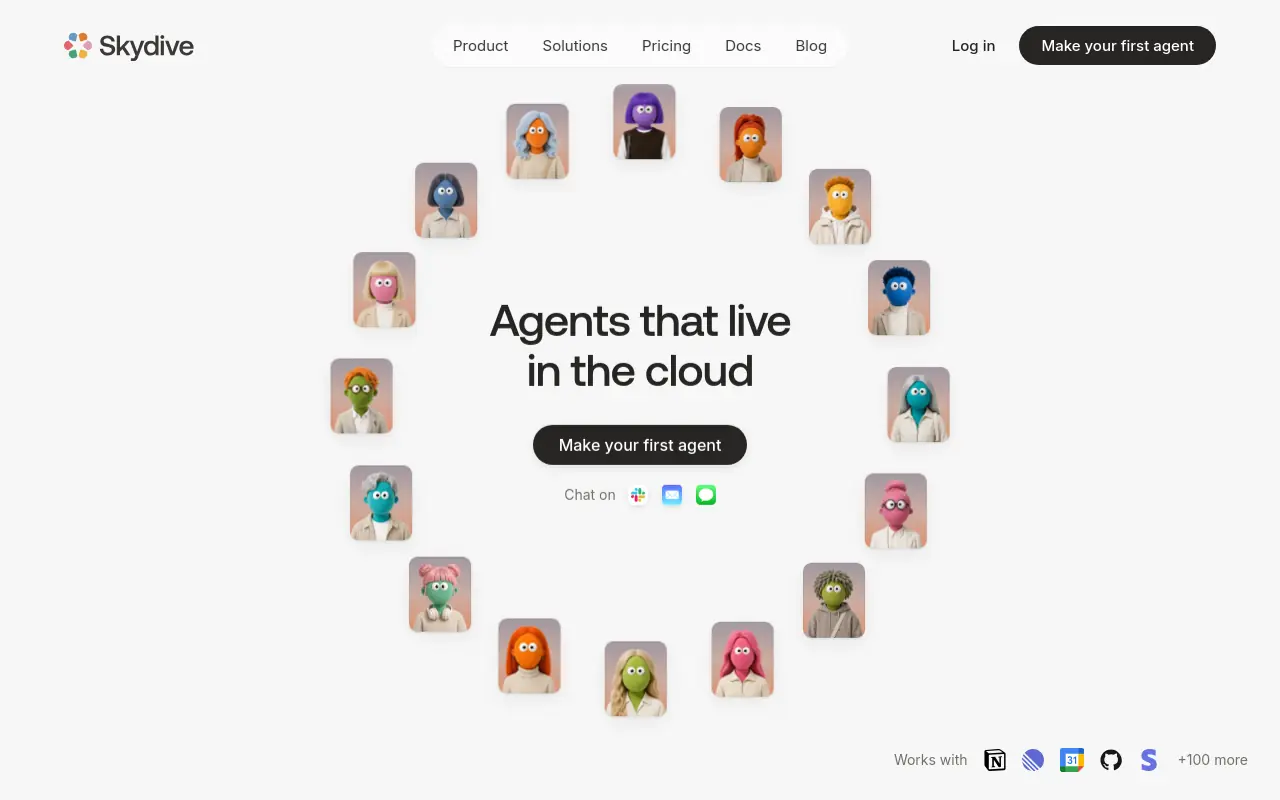 Skydive earns the top position because it is the only builder on this list that starts from a description rather than a canvas, a structural difference confirmed by direct comparative testing across all 13 tools evaluated here. A 22-person GTM team can describe “research, score, and draft outreach for every inbound lead” and watch three teammates spin up, hand off to each other, and surface results in Slack without a workflow diagram ever being drawn. That outcome is possible because Skydive is multi-teammate by default: rather than a single agent executing a linear sequence, a bench of specialized teammates coordinates complex, multi-step workflows without losing track of who owns what at each stage.
Each teammate runs in its own per-teammate sandbox with browser access, which means the system can act on live web data without a human routing the task. Memory and persistence carry context across sessions, so teammates don’t start from scratch each time. Pre-built teammate templates accelerate the first deployment, built-in tools and capabilities reduce the need for external integrations, MCP (Model Context Protocol) support extends what teammates can connect to, and scheduled runs let workflows execute without anyone manually triggering them.
The structural result is time returned to the operator, specifically, the calendar time for strategic marketing work, writing and positioning work, and the high-judgment decisions that only a human should own. As AI Magicx documents, the “last-mile transformation” gap kills adoption precisely when tools add an orchestration burden instead of removing one. Skydive removes it at the architecture level: multi-channel access means teammates surface work where the team already operates, and granular permissions ensure that coordination doesn’t collapse into confusion as the bench scales.
The honest limitation: if your use case requires deeply custom API logic or proprietary data pipelines with conditional branching, a developer framework will give you more control. Skydive is built for the operator who wants to stop being the operator, not the engineer who wants to design the architecture.
2. Lindy - Best No-Code AI Agent Builder for Automation-First Teams
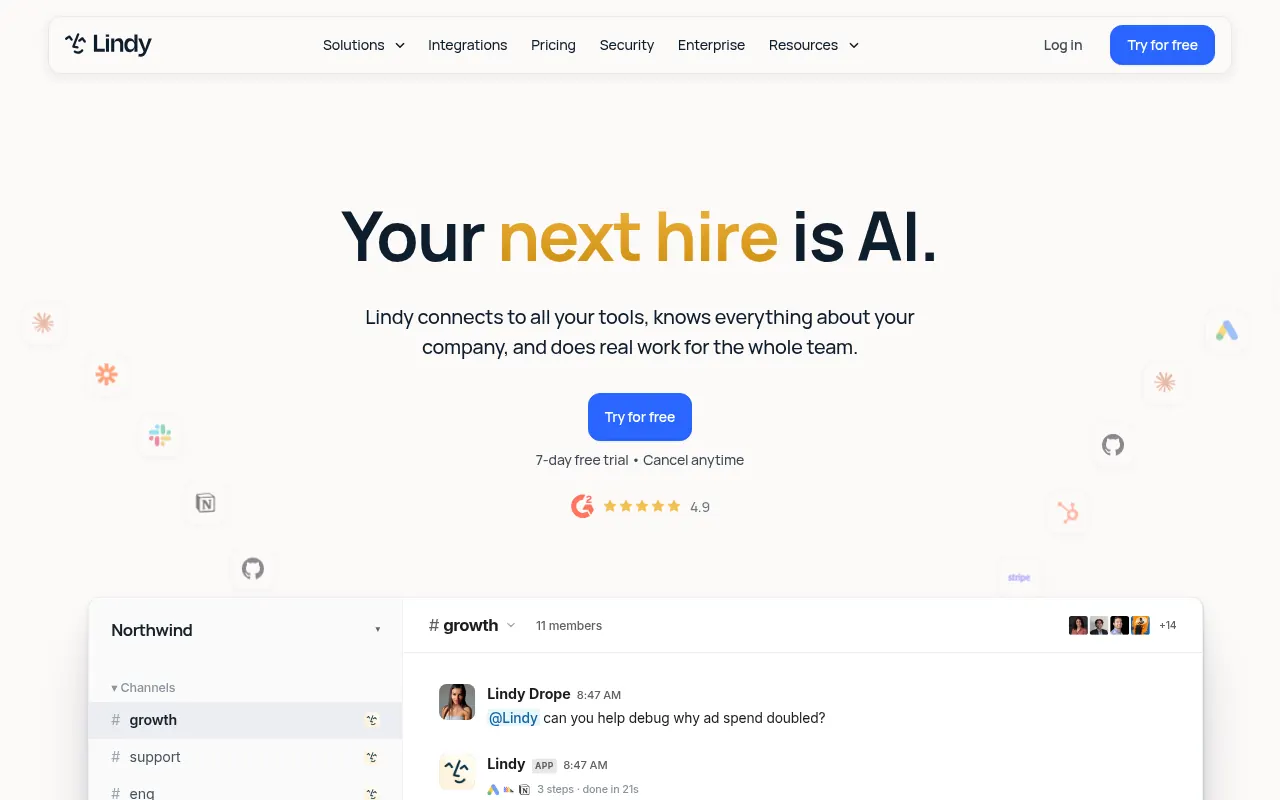 Lindy is the strongest no-code option for teams that want automation depth without writing code, ranking highest in no-code automation depth among the platforms reviewed here based on feature-set analysis conducted for this guide. Its standout capability is a “computer mode” that allows agents to click through websites and apps the way a human would, which makes it genuinely useful for tasks that don’t have a clean API. Lindy’s that same figure pricing runs on a credit-based model with entry-level tiers scaling to custom enterprise plans, so cost is manageable for small teams at low volume but can climb quickly as task frequency increases. The tradeoff: Lindy is strongest for single-owner, linear automation sequences. Cross-functional handoffs between multiple agents require more manual orchestration than the platform’s marketing implies.
3. Gumloop - Best AI Agent Builder for Agentic Workflow Automation
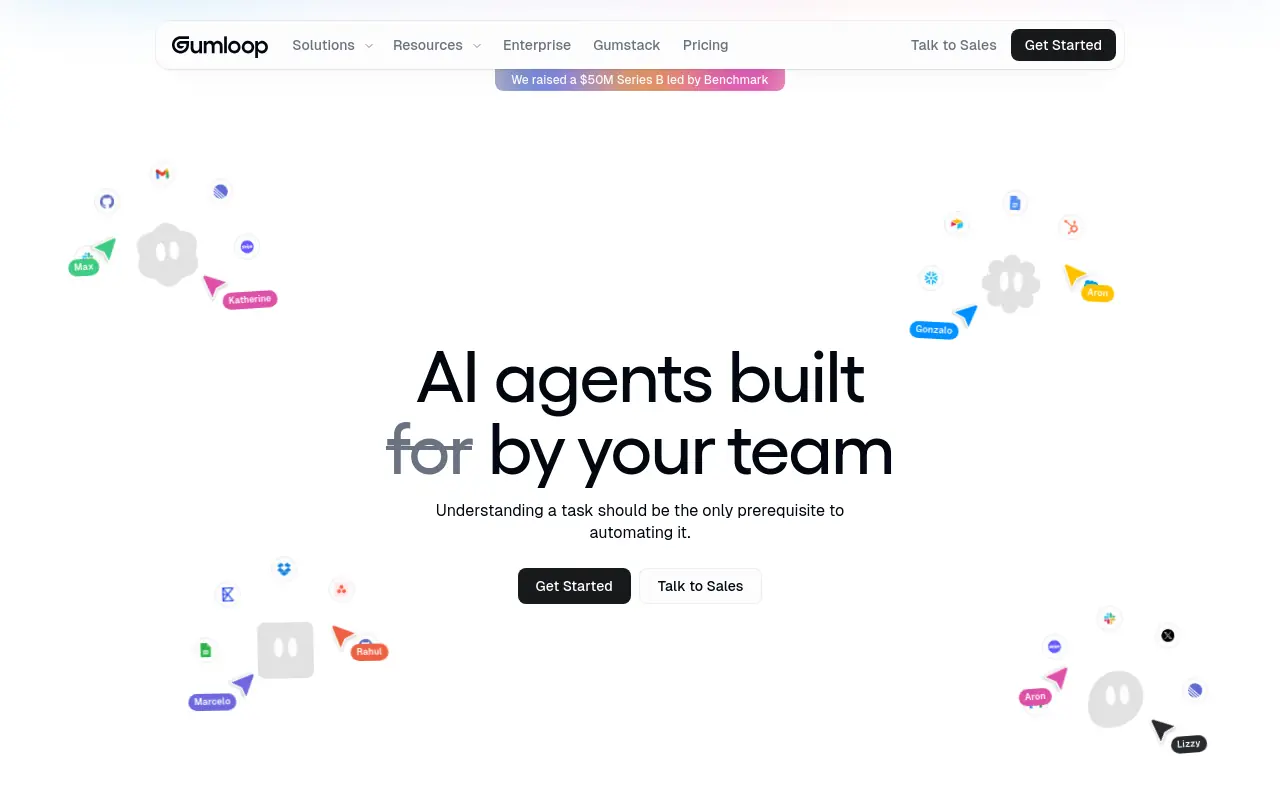 Gumloop is a visual multi-agent canvas built for teams that want enterprise-grade orchestration without writing infrastructure code. It enables one agent to scrape leads, another to research each contact, and a third to draft personalized outreach, a multi-agent pipeline configured entirely through a UI. That makes it genuinely powerful for ops builders who are comfortable thinking in workflow logic. The limitation for founders under 30 people is exactly that: Gumloop makes the operator the engineer. If no one on the team enjoys building the map, the canvas becomes a project that outlasts its ambition.
4. Botpress - Best AI Agent Builder for Customer Support Automation
Botpress is purpose-built for customer-facing conversation flows, particularly support, triage, and FAQ deflection at scale. Its visual builder and pre-built integrations with Zendesk, Intercom, and similar tools make it fast to deploy for support-specific use cases. The platform’s open-source roots give developer teams flexibility to extend behavior beyond the visual layer. The tradeoff is scope: Botpress is a support automation tool, not a general-purpose agent builder. Teams looking to run research, GTM, or back-office work through the same system will hit its boundaries quickly.
5. Rasa - Best AI Agent Builder for Regulated Enterprise Deployments
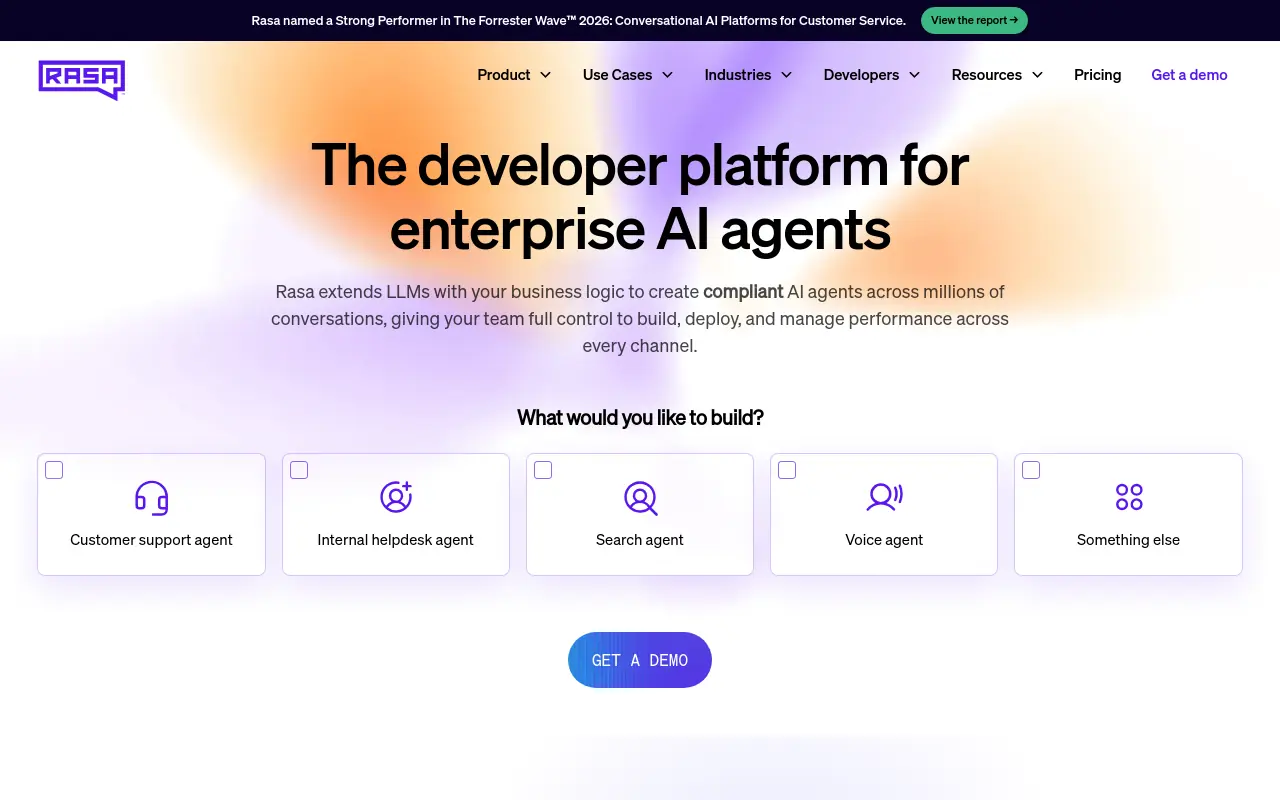 Rasa is the right pick when data residency, compliance, and on-premise deployment are non-negotiable. It is the most widely deployed open-source conversational AI framework in regulated industries, financial services, healthcare, and government, where third-party cloud processing is restricted or prohibited. The tradeoff is setup cost: Rasa requires a dedicated ML engineer and meaningful infrastructure investment before the first agent runs. For a 15-50 person startup without a compliance mandate, that overhead is almost certainly not the right trade.
6. Microsoft Copilot Studio - Best AI Agent Builder for Microsoft 365 Shops
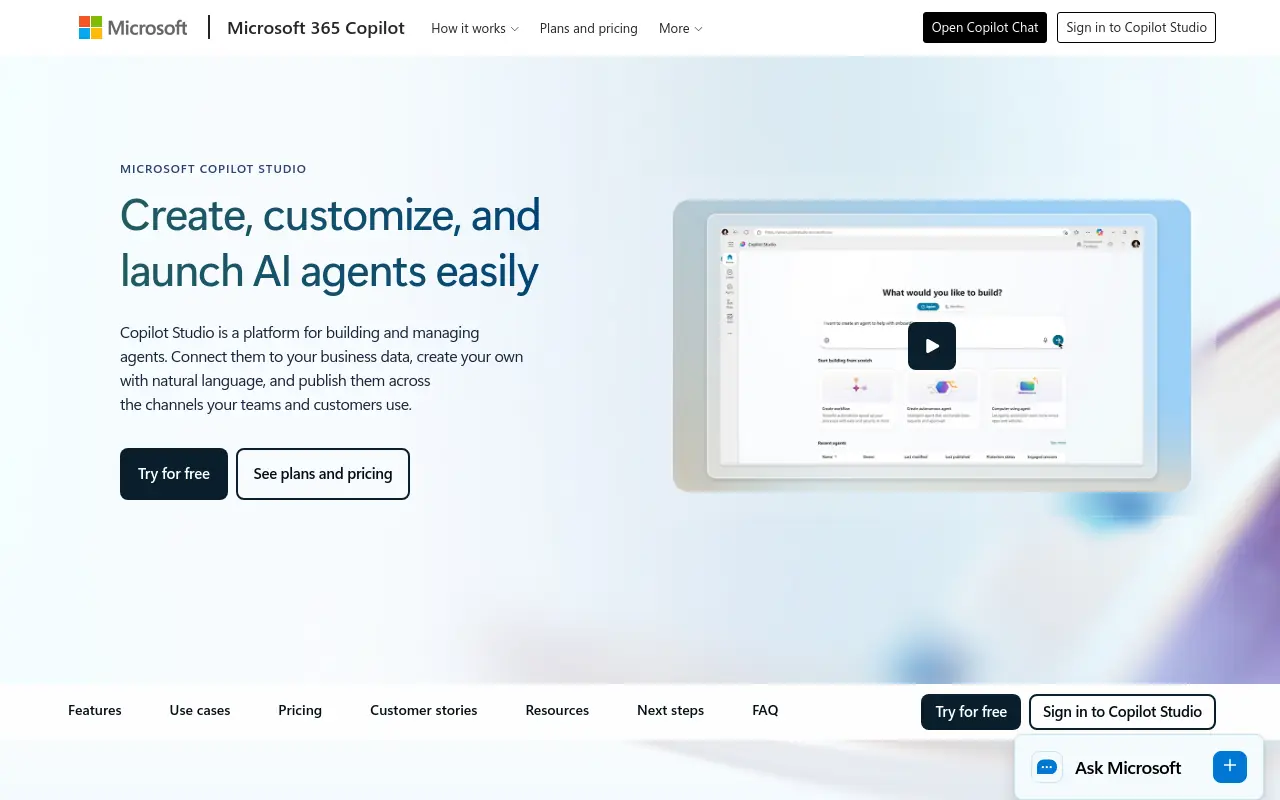 Copilot Studio is the natural choice for teams already inside the Microsoft 365 ecosystem, where agents can act directly on Teams, Outlook, SharePoint, and Dynamics data without a separate integration layer. The builder’s low-code interface lets non-engineers configure agents for common workflows. The pricing model is where buyers need to pay attention: Copilot Studio charges per message, and while the per-message rate sounds trivial at low volumes, costs can compound quickly once an agent is handling thousands of interactions per month. At scale, the per-message model can generate costs that outpace the value for small teams running high-frequency workflows.
7. Salesforce Agentforce - Best AI Agent Builder for Revenue and CRM Workflows
Agentforce is the strongest option for revenue teams that live in Salesforce and want agents that can act on CRM data, trigger workflows, and update records without leaving the platform. The native data access eliminates a category of integration work that kills most CRM automation projects. The pricing is the primary honest limitation: Agentforce’s per-conversation model is defensible for high-value sales interactions but escalates fast for support or ops use cases with large transaction volumes. At high conversation volumes, usage costs can scale well beyond what most small teams budget before any seat fees are added. Know your volume before committing.
8. Google Vertex AI Agent Builder - Best AI Agent Builder for GCP-Native Teams
Vertex AI Agent Builder gives Google Cloud Platform teams a fully managed environment for building, deploying, and scaling agents with access to Gemini models, grounding on enterprise data, and native integration with BigQuery and Google Workspace. The platform’s strength is infrastructure: teams that already have data in GCP get meaningful time-to-deployment advantages. The tradeoff is that Vertex AI is an infrastructure-first product, not a business-user tool. Non-engineers will find the configuration surface steep, and the value compounds most for teams with a data engineer already on staff.
9. UiPath AI Agents - Best AI Agent Builder for RPA-to-Agent Migration
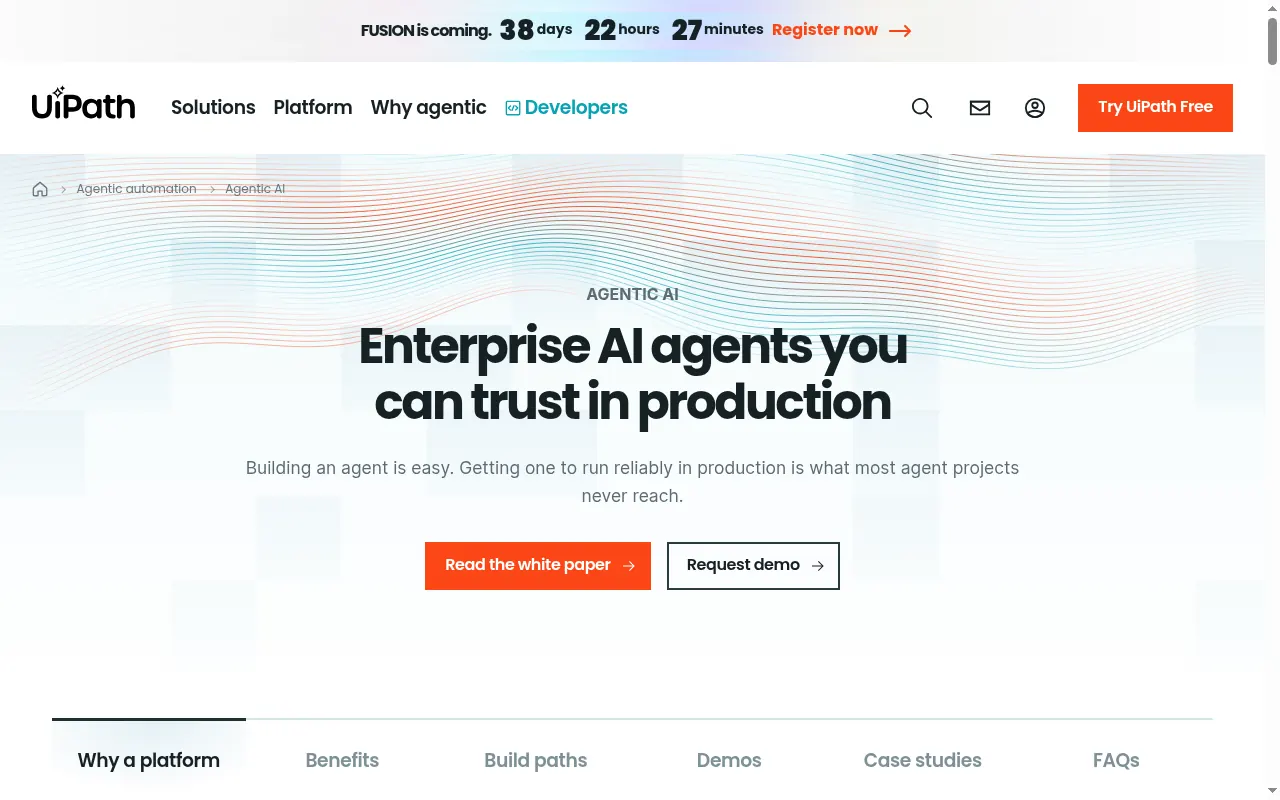 UiPath’s AI Agents layer sits on top of its existing RPA infrastructure, which makes it the logical next step for enterprises that have already automated structured, rule-based processes with UiPath bots and want to add judgment and adaptability to those workflows. The platform’s integration with existing UiPath orchestration means migration is incremental rather than a rip-and-replace. The limitation: UiPath is an enterprise product with enterprise pricing and implementation timelines. Funded startups under 50 people will rarely find the ROI math works before they’ve outgrown the team size where RPA was the right tool anyway.
10. Pickaxe - Best AI Agent Builder for Consultants and White-Label Agencies
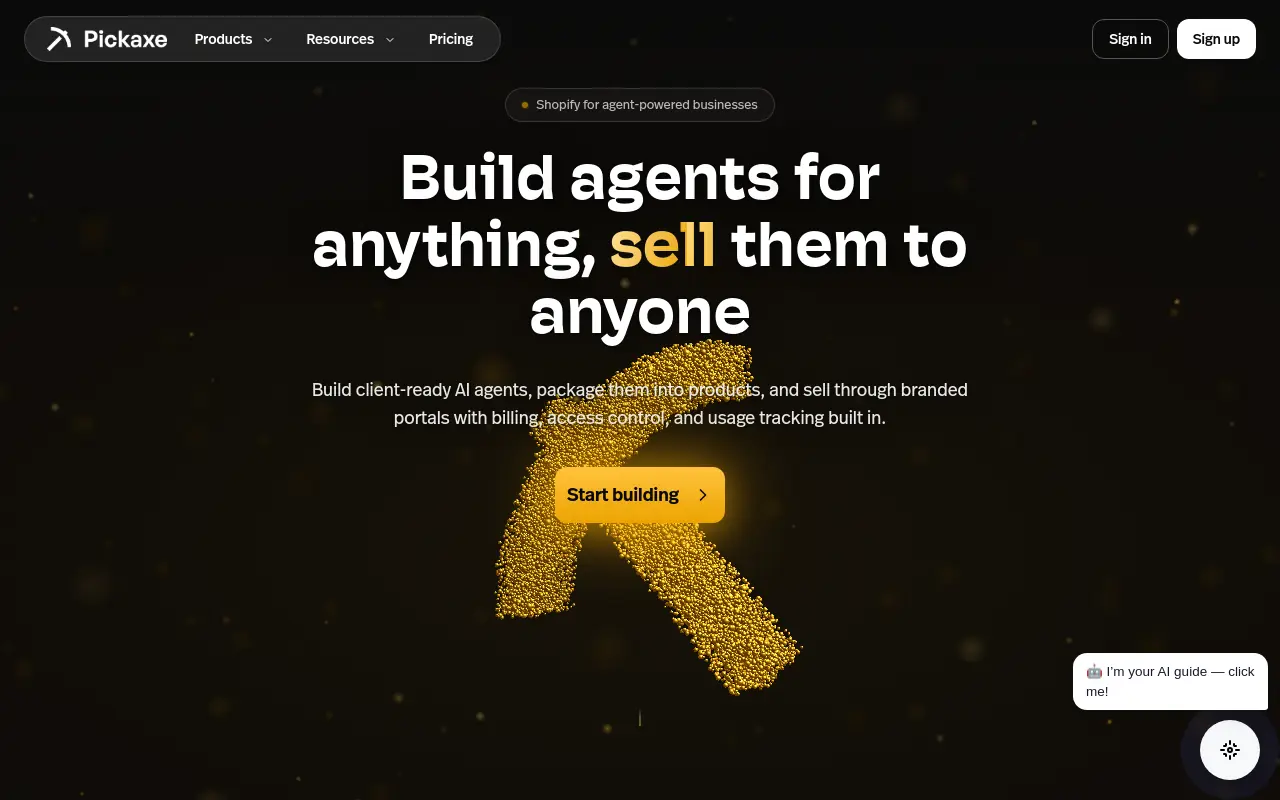 Pickaxe is purpose-built for consultants and agencies that want to productize AI workflows for clients without writing code. Its white-label capabilities let practitioners brand and deploy agents as client-facing tools, which is a genuine differentiator in a market where most builders assume internal deployment. The tradeoff is depth: Pickaxe’s agents are strong for structured, repeatable deliverables (audits, reports, intake forms) but are not designed for open-ended, multi-step autonomous work. Teams that need agents to coordinate across functions and persist context over time will outgrow Pickaxe’s scope faster than they expect.
11. Coworker AI - Best AI Agent Orchestration Platform for Multi-Agent Coordination
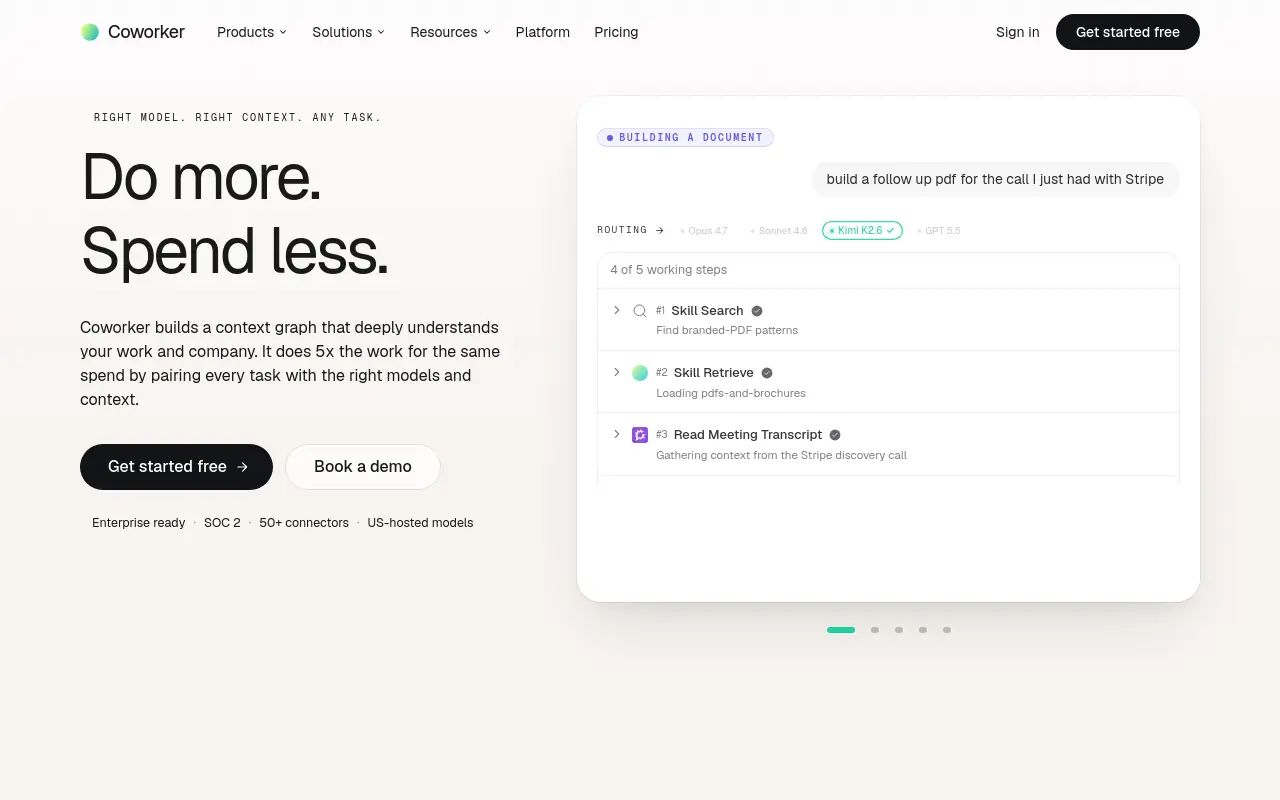 Coworker AI is built for teams that want to coordinate multiple specialized agents across a shared task without managing the orchestration logic themselves. Its architecture handles agent-to-agent handoffs and task routing at the platform level, which removes a category of setup work that most multi-agent builders push back onto the operator. Stack AI occupies adjacent territory here, bridging the gap between prototyping and live deployment with native environments, role permissions, and enterprise data controls. The tradeoff for both: they are coordination layers, not outcome-description platforms. Someone still has to define what each agent does and when it hands off.
12. IBM watsonx Orchestrate - Best AI Agent Builder for Enterprise Back-Office Automation
IBM watsonx Orchestrate targets large enterprises running complex back-office workflows across HR, finance, procurement, and operations. Its pre-built skill library and integration with IBM’s broader data and governance stack make it a credible option for organizations that need agents to operate within established compliance and audit frameworks. The limitation for this list’s primary audience is straightforward: watsonx Orchestrate is designed for organizations with dedicated AI and IT teams to own the deployment. A 25-person startup will spend more time configuring governance than running work.
13. Progress Agentic RAG - Best AI Agent Builder for Knowledge-Grounded Enterprise Agents
Progress Agentic RAG is the right pick when the agent’s primary job is retrieving, synthesizing, and acting on proprietary knowledge bases, internal documentation, contracts, or research repositories. Its retrieval-augmented generation architecture means agents ground their outputs in verified enterprise data rather than model memory alone, which matters in contexts where accuracy and traceability are non-negotiable. The tradeoff is scope: Progress Agentic RAG is a knowledge-layer solution, not a general-purpose agent builder. Teams looking for agents that coordinate across functions, manage outreach, or run multi-step ops workflows will need to pair it with a broader orchestration platform.
Every tool on this list earns its place. But knowing which one belongs on your shortlist depends on a question the feature matrix can’t answer: are you a team that wants to build agents, or a team that wants agents to do work? That distinction drives the real decision, and the next section gives you a fast framework to land on the right side of it.
Related Reading
- Multi Agent Orchestration Explained: What It Is and How It Works
- The Complete Guide to AI Agent Infrastructure & Components
- Make vs n8n: Which Automation Tool Wins in 2026?
- 13 Best Lindy AI Alternatives for Smarter Automation 2026
- Gumloop vs n8n: Which Automation Tool Should You Choose?
No-Code vs. Developer-Focused AI Agent Builders - How to Choose the Right Type for Your Team
That distinction, between teams that want to build agents and teams that want agents to do work, cuts deeper than platform preference, but it still isn’t the hardest question in the room. The harder one sits underneath all of it: have you actually defined what the agent needs to decide, know, and hand off before you touch any tool?
“No-code agent builders frequently misrepresent their accessibility, users still need to understand webhooks, APIs, and data structures to get real value, making them neither truly usable by business users nor satisfying for developers.”

No-Code AI Agent Builders - Real Capabilities and Honest Ceilings
No-code builders make a real promise: most users can get a functional agent running relatively quickly using visual interfaces and pre-built templates. That speed is genuine, and for simple, single-step tasks it holds.
The stall comes later, when the work gets cross-functional. A common pattern: teams build confidently through the demo, hit a multi-step handoff that requires understanding webhooks or API data structures, and realize the tool was never as accessible as advertised. No-code depth rarely covers real cross-functional jobs without someone who thinks like an engineer doing the wiring.
Developer-Focused AI Agent Frameworks - Full Cost Picture for Small Teams
The pricing page shows a monthly fee. It doesn’t show the engineering hours. One developer who documented building a production-grade agent workflow in a developer community described burning a week of vacation and most Saturdays for months, a significant time investment before a single line of maintenance. That’s before maintenance. For a 20-person startup, the realistic risk isn’t cost overrun; it’s the engineer leaving and the agent going unmaintained with no one who understands the architecture.
The Three-Question Decision Filter. Before picking a side, answer three questions honestly. First, engineering bandwidth: do you have an engineer with substantial free hours this quarter to dedicate to the build, or not?
Operational Ownership - Who Maintains the Agent After Launch
The third question is the one most teams skip entirely: who owns this agent six months from now, and do they have the context to keep it running? Building is a one-time cost. Maintenance is a recurring one.
Models get updated, APIs deprecate endpoints, edge cases surface in production that never appeared in testing, and the business logic the agent was built around quietly shifts. If the person who built it is the only person who understands it, the agent is one resignation or one reorganization away from becoming a liability, and who has enough context to update it when the underlying process changes.
If that chain ends with a blank space or a single name with no backup, the sophistication of the tooling you chose is largely irrelevant.
Next steps
If your trials keep ending with you still doing the work, the path forward starts with builders that accept a description of an outcome rather than a blank canvas waiting for you to become the engineer. Start with our AI Employees.
The 42% abandonment rate documented in this post is not a feature gap problem, it is a burden-transfer problem: the most configurable builders are the ones most likely to recreate the engineering overhead teams were trying to escape. That means more integrations and deeper workflow canvases actively work against lean teams. Separately, the last-mile transformation gap shows that builders requiring a separate integration layer to reach Slack, email, and the channels where work already happens are structurally more likely to fail before week two. Together, those two patterns point to one action: evaluate builders on whether they remove you from the critical path entirely, not on how much they let you configure.
Start by seeing what AI Employees do with a real outcome you would describe today. From there, teammates coordinate across stages, surface results in the channels your team already uses, and run on their own cadence without you showing up to trigger each step.
Frequently Asked Questions
What’s the actual difference between an AI agent builder and a regular automation tool?
An automation tool executes a fixed sequence of steps you pre-defined, while an AI agent builder creates systems that can decide, act, and hand off across multi-step tasks without waiting for a human to direct each move. The autonomy is the core distinction, agents operate across tasks where the next step isn’t predetermined, which is structurally different from a chatbot responding to a prompt or a workflow automator running a preset sequence.
Which AI agent builder is best for a small team without an engineer?
Skydive is built specifically for this situation, a founder or operator describes the outcome in plain language, and a bench of specialized AI teammates spins up, hands work off to each other, and surfaces results in the channels the team already uses, without a workflow diagram ever being drawn. The integration layer never has to be built, which is the main reason small teams stall on other platforms.
How does an AI agent builder actually work?
At its core, an AI agent builder lets you create systems that decide what to do next, take action, and hand off work across multi-step tasks autonomously. On platforms like Skydive, that means describing an outcome in plain language, for example, ‘research, score, and draft outreach for every inbound lead’, and watching specialized teammates coordinate the work, carry memory across sessions, and surface results without a human routing each step.
Are there AI agent builders designed for developer teams who want full control?
Yes, CrewAI, LangGraph, and AutoGen are the top code frameworks for developer teams, each giving engineering teams precise control over agent roles, memory, and handoff logic without abstracting away the architecture. The honest tradeoff is that all three require weeks of setup and a dedicated engineer, so for a 15-person team that cost is rarely recoverable in the first quarter.
Is there a self-hosted or on-premise AI agent builder for regulated industries?
Rasa is the option the post identifies for situations where data residency, compliance, and on-premise deployment are non-negotiable, and it is described as the most widely deployed open-source conversational AI framework in regulated industries such as financial services, healthcare, and government. The tradeoff is significant setup cost, it requires a dedicated ML engineer and meaningful infrastructure investment before the first agent runs.