Types of Multi Agent Collaboration Frameworks Explained
Multi agent collaboration frameworks explained so ops leaders stop losing context across tools and get real coordination without manual handoffs.
 Skydive 25 min read
Table of contents
Single agents don’t fail because they’re not smart enough. They fail because coordination is an architecture problem, and intelligence alone can’t fix it.
Most teams hit the wall before they understand why. A request lands in Slack, requires a judgment call from the CRM, triggers an action in a project tool, and needs a reply in email. The human in the middle, usually the Head of Ops, becomes the only agent capable of holding all of it together. The common assumption is that the solution is a more detailed workflow diagram or a smarter single agent that can hold more context at once. This is an architecture problem. See our AI Employees for how this works in practice.
Understanding how teams of AI agents solve this requires first understanding what a single agent cannot do, and why adding intelligence to that single agent does not fix the underlying constraint. Multi-agent collaboration means multiple autonomous AI agents working together toward a shared goal, each handling a distinct part of the task rather than one agent attempting all of it. Think of a research report: one agent gathers sources, a second synthesizes findings, a third drafts the output, and a fourth reviews for accuracy.

Each operates within a focused context. None tries to hold everything at once. The ceiling is not intelligence.
It is coordination architecture.
The ceiling is not intelligence. It is coordination architecture.
Research has documented that LLM performance can degrade as context length increases, even when relevant information is present in the window, so giving a single agent a bigger context window does not reliably solve the underlying problem. The degradation is caused by context length itself, not by retrieval failure. The bottleneck follows directly.
One agent handling research, drafting, review, and cross-tool execution simultaneously is not a capable generalist. It is a system under load, dropping earlier context as new inputs arrive and producing outputs that look complete but quietly omit what it could no longer hold. For a Head of Operations whose day fragments across tools, threads, and channels, that loss is not theoretical.
It is the CRM note that never made it into the project brief. The handoff that required a human to chase it down.
Key takeaways
- The bottleneck in most AI workflows isn’t model capability, it’s coordination architecture built around a single agent talking to a single human.
- Multi-agent collaboration only works when agents hand off context to each other without a human relaying outputs between tools in the middle.
- Sequential, hierarchical, and network patterns aren’t stylistic preferences, each one is a direct answer to a specific coordination failure, and picking the wrong one rebuilds the problem with more moving parts.
- Context length is not a substitute for coordination, LLM performance degrades with longer contexts even under perfect retrieval, which makes distributing work across focused agents architecturally necessary, not optional.
- AutoGen, CrewAI, and LangGraph all provide solid infrastructure for multi-agent systems, but none of them solves the integration layer connecting agents to the tools where real work actually lands.
- Specialization, robustness, and scalability are outcomes that require deliberate architecture, not defaults that appear because you added more agents.
- Skydive closes the integration gap by embedding AI teammates directly inside Slack, email, iMessage, and web chat, so agents handle real work inside the tools teams already use, without a human in the middle of every handoff.
The Core Mechanisms That Enable Agents to Work Together: and Where Systems Break Without Them
Three capable agents, zero coordination, and a Head of Ops spending her afternoon manually relaying outputs between tools she was told would talk to each other. That is a structural problem, and it shows up in teams long before they realize what they are actually missing. The instinct is to add more steps to the workflow or upgrade to a model with a larger context window. Neither addresses the structural problem underneath, and both cost real time before the team discovers it.

Communication - How Agents Exchange Data Mid-Task and What a Lost Message Actually Costs
Communication allows agents to exchange intermediate results, status signals, and feedback through structured protocols or natural language handoffs. Without it, a research agent can complete its task perfectly and still leave the writing agent waiting indefinitely, because no protocol exists to signal that the work is ready. Research published in Why Do Multi-Agent LLM Systems Fail? (Cemri et al., arXiv 2503.13657, 2025) finds that inter-agent communication breakdowns, including malformed outputs and unacknowledged messages, are classified as a primary failure mode in multi-agent systems, producing silent failures where no agent detects that a task was dropped.
A lost message creates an invisible stall that looks, from the outside, like the system is running fine.
Specialization - Why Assigning Distinct Roles Beats Asking One Agent to Do Everything
Specialization assigns distinct roles or domains of expertise to different agents: a researcher, a coder, a reviewer. The same MAST taxonomy from Cemri et al. identifies specialization failures, where agents operate outside their designated roles, as a root-cause category, not a symptom of weak prompts. When an agent is asked to research, draft, and verify simultaneously, it does not fail loudly. It degrades quietly, producing outputs that are slightly off in ways that compound across steps. The practical implication is direct: task allocation must route each sub-task to the agent built for it, or specialization delivers nothing.
Coordination - The Mechanism That Decides Who Owns What and When to Hand Off
Coordination dictates how agents manage workflow, resolve conflicts, and decide task allocation, whether through a centralized orchestrator or a decentralized peer-to-peer network. Centralized designs offer clearer audit trails and easier conflict resolution; decentralized designs increase robustness but require careful goal-alignment work to prevent agents from producing conflicting outputs or waiting on each other indefinitely. The choice of coordination mechanism determines whether the system scales or stalls.
The Seam Problem - How Communication, Specialization, and Coordination Failures Compound
Each mechanism fails independently. The deeper problem is that they fail together. A communication breakdown starves a specialized agent of the input it needs, which triggers a coordination gap when no signal ever arrives to move the workflow forward.
The failure is multiplicative. A lost message that goes undetected by the communication layer means the specialization layer never activates, which means the coordination layer has nothing to sequence. From the outside, the system appears to be running.
The output simply never arrives. For a Head of Operations already holding a fragmented stack of tools and threads together, that silent compounding is indistinguishable from a system that was never set up correctly in the first place.
The Core Architectural Components of a Multi-Agent System - Agents, Environment, Orchestration, Protocol
Four architectural components determine whether you have a multi-agent system or a collection of isolated processes running in parallel. The core synthesis here is that context length is not a coordination substitute, distributing work across focused agents is architecturally necessary, not merely convenient, because LLM performance degrades with longer contexts even under perfect retrieval, and inter-agent communication failures (not agent reasoning limits) are the primary driver of system-level breakdowns. The four components are:
- Agent
- Environment
- Orchestration
- Protocol
These are non-negotiable load-bearing elements, not optional enhancements to a single-agent setup.
Get all four right, and agents hand off to each other without a human in the middle. Miss even one, and according to the LangChain State of AI Agents Report, you lose the coordination layer that separates genuine collaboration from parallel chatbots.
1. Agents - The Autonomous Decision-Making Units Powering Multi Agent Collaboration
Agents are the individual AI entities that form the foundation of any multi-agent architecture. Each carries a defined persona, a system prompt, and access to specific tools, as the LangChain State of AI Agents Report documents. The critical design decision here is specialization: a research agent and a drafting agent each go deep rather than broad.
One friction point teams run into early is that existing agent SDKs spawn a separate CLI process per agent. When every agent lives in its own process, deployment overhead compounds fast: you are managing process lifecycles, environment variables, and port conflicts before you have written a single line of business logic, and in-process multi-agent orchestration becomes structurally difficult rather than incidentally annoying. Skydive sidesteps this entirely by being multi-teammate by default: teammates run within a shared runtime rather than as isolated CLI processes, so the deployment surface stays flat even as the number of active agents grows.
The real tradeoff is that specialization only delivers value when the other three components are in place to route tasks correctly. Without them, a specialized agent is just a capable process with nowhere to send its output.
2. Environment - The Shared Operational Context That Grounds Every Agent Interaction
The shared environment is the common workspace where agents observe state, post intermediate outputs, and read what other agents have produced. Without this layer, agents cannot observe each other’s work, so every handoff requires a human to copy and paste context between tools. The LangChain State of AI Agents Report identifies this shared context as a non-negotiable coordination requirement, not an optional convenience.
Skydive addresses this directly: each teammate operates inside its own per-teammate sandbox with browser access, while memory and persistence ensure that what one teammate produces is available to the next without manual forwarding. Built-in tools and capabilities are accessible across the shared environment, so teammates draw from the same operational surface rather than maintaining redundant, siloed toolsets. The result is that the environment itself carries continuity, agents read current state rather than reconstructing it from a human-relayed summary.
3. Orchestration - The Control Layer That Sequences and Prioritizes Agent Workflows
Orchestration governs how agents interact: whether through a supervisor agent delegating to specialists, a sequential pipeline, or peer-to-peer collaboration. A centralized orchestrator is simpler to reason about but creates a single point of failure; decentralized patterns are more resilient but harder to audit when a workflow goes wrong. Most teams hit this tradeoff after they have already wired agents together and discovered that task sequencing without a control layer defaults back to a human making the calls.
The practical version of that problem, for teams coordinating real work, is losing track of who owns what at each stage of a multi-step workflow. When ownership is implicit, status checks pile up and the communication overhead that was supposed to disappear simply moves from agent logs to Slack threads. Skydive is built to coordinate teams through complex, multi-step workflows without losing track of who owns what at each stage: granular permissions and team collaboration controls make ownership explicit at the system level, and scheduled runs mean sequenced steps execute on cadence without a human queuing them. The back-and-forth that pulls team members away from high-impact work gets absorbed by the orchestration layer, not handed back to a manager.
4. Communication Protocol - The Structured Message Layer That Enables Reliable Agent-to-Agent Coordination
A communication protocol is the structured message format that governs how agents pass outputs, status signals, and error flags to each other. Without a defined protocol, handoffs rely on implicit assumptions about format and timing, assumptions that hold in a demo and break under real operational load. The LangChain State of AI Agents Report identifies protocol mismatches as a primary cause of silent failures in production deployments: an agent sends output in a format the receiving agent cannot parse, the message is dropped without an error, and the workflow stalls with no log entry to explain why.
Skydive’s support for MCP (Model Context Protocol) is the architectural answer to this class of failure. MCP provides a standardized message layer so that when one teammate hands off to another, whether across tools, across channels via multi-channel access, or across pre-built teammate templates, the receiving agent gets a parseable, structured payload rather than a free-form string that collapses under edge cases. A well-designed protocol makes every handoff explicit, timestamped, and recoverable, which is the difference between a system a Head of Operations can trust and one she has to watch.
Common Multi-Agent Collaboration Patterns - Sequential, Hierarchical, and Network: and Which Pain Each Solves
Pick the wrong pattern and you don’t just slow the system down, you rebuild the exact coordination failure you were trying to escape, with more moving parts and no clearer owner.
That’s the trap most teams fall into. They treat sequential, hierarchical, and network patterns as architectural preferences rather than direct answers to specific human bottlenecks. The reality, borne out across the market, is that each pattern carries a distinct coordination logic, and choosing the wrong one for your workflow replicates the fragility it was meant to remove.
The frustration is real and familiar: teams trying to get multi-step automation working often describe the experience as hitting wall after wall, not because the individual steps are wrong, but because the coordination layer between steps was never designed for the actual shape of the work. That gap is a pattern-matching failure, not a tooling failure.
Here is what each pattern actually solves, and where each one breaks.
1. Sequential Multi-Agent Collaboration - Best for Predictable, Ordered Pipelines
In a sequential pipeline, agents process tasks in a chain: one agent completes its step and passes the output to the next. This pattern fits linear workflows cleanly, a research agent feeds a drafting agent, which feeds an SEO-review agent. The critical tradeoff, as broader industry trends confirm, is brittleness: a single agent failure collapses the entire pipeline, replicating the same fragility as a human relay chain. If your workflow has optional branches or variable steps, sequential design is the wrong starting point.
Where Skydive fits: sequential patterns work best when each teammate in the chain has a tightly scoped role. Skydive’s per-teammate sandboxes with browser access keep each step isolated, so when you do build a linear pipeline, each agent operates in its own contained environment rather than sharing state that one bad output can corrupt.
2. Hierarchical Multi-Agent Collaboration - Best for Complex Tasks Requiring Delegation and Oversight
A hierarchical pattern places a manager agent at the center: it decomposes a complex goal into sub-tasks and delegates each to a specialist worker agent. A customer-support system where a triage agent routes tickets to billing, technical, or returns specialists is a clean example. This design directly solves the “who owns what” coordination problem that causes handoff breakdowns, because task allocation is explicit, not assumed.
This is precisely the coordination challenge Skydive is built around: coordinating your team through complex, multi-step workflows without losing track of who owns what at each stage. Granular permissions and team collaboration controls mean the delegation structure isn’t just a prompt-engineering choice, it’s enforced at the platform level, so a worker agent can’t drift into territory that belongs to a different teammate. Pre-built teammate templates give teams a faster starting point for common hierarchical configurations without rebuilding orchestration logic from scratch.
The honest limitation is overhead: building a reliable orchestration layer requires upfront design work, and the manager agent’s prompt logic becomes the single point of quality control for everything downstream. That overhead is exactly what most teams report as the structural cost of centralized multi-agent coordination.
3. Network (Peer-to-Peer) Multi-Agent Collaboration - Best for Dynamic, Emergent Problem-Solving
Network multi-agent collaboration connects agents as peers that communicate laterally, share findings, and self-organize without a central controller, resembling how expert teams brainstorm. This pattern shines for open-ended tasks like competitive analysis or creative generation where no fixed sequence exists and diverse agent perspectives improve output quality. The significant tradeoff is coordination overhead: without a central authority, agents can produce redundant work, enter feedback loops, or generate conflicting outputs that are hard to reconcile.
Multi-Agent Collaboration Frameworks - AutoGen, CrewAI, and LangGraph Compared
Three capable frameworks exist for building multi-agent systems. Each one solves a real problem. None of them tells you how to wire agents into the tools where your team actually works.
“Existing multi-agent frameworks (CrewAI, AutoGen, LangGraph) are not model-agnostic by default, forcing users to commit to a single LLM provider across their agent workflows.”
AutoGen, CrewAI, and LangGraph all provide infrastructure for building and running multi-agent systems, but leave the integration layer connecting agents to external tools entirely to the builder, a consistent pattern documented across their official documentation, community discussions, and practitioner accounts from teams who have shipped production systems on each framework. It means every team using any of these frameworks faces the same hidden project after the agent logic is done: connecting it to Slack, email, a CRM, a ticketing system, or wherever decisions actually get made. That is the integration tax. It rarely shows up in the documentation until you are already deep in the build.
There is a second tax that shows up even earlier, and it is quieter. When multiple agents write to shared state concurrently, one agent’s output can silently overwrite another’s with no error thrown, a last-write-wins collision that produces invisible data loss. Teams building on these frameworks discover this failure mode well into a project, often because a workflow produced a wrong answer rather than a visible crash. And because most of these frameworks are not model-agnostic by default, teams are also forced to commit to a single LLM provider across their entire agent workflow, a constraint that limits both flexibility and cost management across the stack.
Pros and cons at a glance
| ✓ Pros | ✗ Cons |
|---|---|
| Flexible agent topologies | Requires significant prompt engineering to coordinate agent behavior reliably |
| Strong built-in support for code-execution agents | Integration layer connecting agents to business tools is yours to build from scratch |
| Strong built-in support for human-in-the-loop patterns | Shared-state concurrency can produce silent data loss, difficult to detect and debug |
1. AutoGen - Best for Conversational Multi-Agent Collaboration with Flexible Agent Topologies
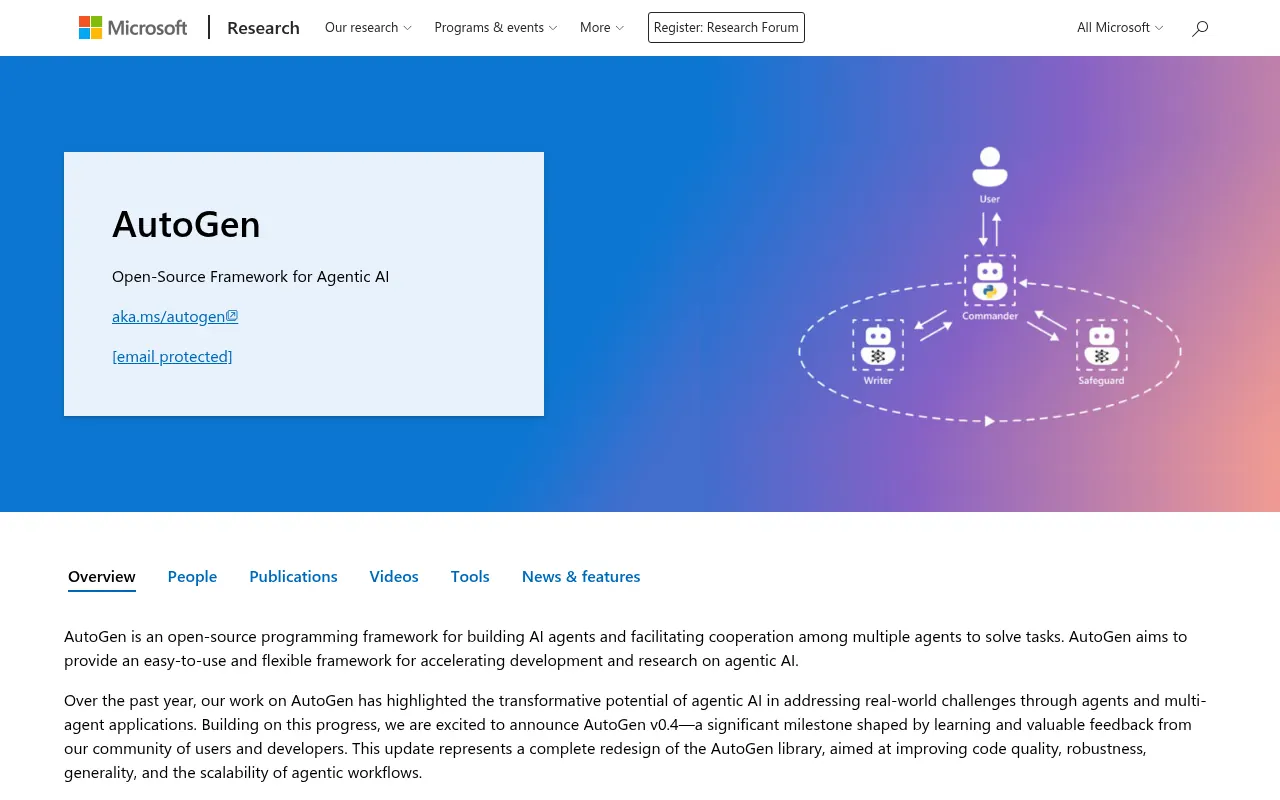 AutoGen (Microsoft) enables conversational multi-agent systems where agents communicate via natural language messages, with strong built-in support for code-execution agents and human-in-the-loop patterns. It is the right pick when your team needs flexible agent topologies and has Python engineering capacity to configure them. The tradeoff is real: AutoGen requires significant prompt engineering to coordinate agent behavior reliably, the integration layer connecting agents to business tools is yours to build from scratch, and, as practitioners have flagged in Microsoft AutoGen GitHub Discussions, shared-state concurrency between agents can produce silent data loss that is genuinely difficult to detect and debug in production.
2. CrewAI - Best for Role-Based Multi-Agent Collaboration with Low-Code Orchestration
 CrewAI organizes agents around the abstractions of crews and tasks, making hierarchical multi-agent patterns intuitive to define without deep ML engineering knowledge. For non-technical operators who need a working prototype quickly, it is the fastest starting point in this comparison. The limitation that matters: the integration layer connecting agents to existing external tools and data systems must still be built separately, so the low-code orchestration advantage disappears the moment agents need to touch a real business system. CrewAI also defaults to a single LLM provider across agent workflows, which becomes a meaningful constraint as teams scale or want to route different tasks to different models, a limitation documented across AI Helper Desk’s comparative coverage of these frameworks.
3. LangGraph - Best for Stateful, Graph-Driven Multi-Agent Collaboration in Production
LangGraph uses a graph-based orchestration model that supports complex conditional flows and stateful agents, enabling non-linear workflows that sequential frameworks cannot express. It is the strongest choice for teams with dedicated ML engineering resources who need production-grade control over agent behavior. One team building a hierarchical support-ticket triage system reported spending the majority of the project connecting agents to Zendesk, Slack, and their CRM rather than designing agent logic. LangGraph’s graph model gives you fine-grained control over state transitions, but managing concurrent writes to shared state across agents still requires custom logic; the framework does not prevent silent overwrites out of the box.
The pattern across all three is the same. Orchestration is solved. The integration layer is not. The shared-state collision problem is not. The LLM lock-in problem is not. Teams that underestimate these gaps do not stall because they chose the wrong framework. They stall because no framework chose their tools for them, guarded their data integrity for them, or let them swap models without rebuilding their agent configuration.
Skydive is built around these exact gaps. Each teammate runs in its own per-teammate sandbox, which eliminates the concurrent-write collisions that cause silent data loss when multiple agents share state. Teammates are multi-channel by default, connected to Slack, email, and the business systems where decisions actually happen, removing the integration tax entirely rather than deferring it.
And because Skydive supports MCP (Model Context Protocol) and is designed for model flexibility, teams are not locked to a single LLM provider across their workflows. Where these frameworks hand you the wiring diagram and leave, Skydive coordinates your team through complex, multi-step workflows without losing track of who owns what at each stage, with granular permissions, memory and persistence, scheduled runs, and pre-built teammate templates that reduce the back-and-forth communication overhead so your team stays focused on high-impact work instead of status updates.
Choosing the right framework gets agents talking to each other. But the value those agents deliver depends entirely on what they can actually do once the conversation starts, and that depends on how the system handles specialization, robustness, and scalability in practice.
Related Reading
- The Complete Guide to AI Agent Infrastructure & Components
- Make vs n8n: Which Automation Tool Wins in 2026?
- 13 Best Lindy AI Alternatives for Smarter Automation 2026
- Gumloop vs n8n: Which Automation Tool Should You Choose?
- 13 Best AI Agent Builders in 2026
- Multi Agent Orchestration Explained: What It Is and How It Works
Key Benefits of Multi-Agent Systems - Specialization, Robustness, and Scalability (And What Undermines Each)
The three core benefits of multi-agent systems are real. The problem is that most teams treat them as defaults rather than outcomes, and that assumption is where the architecture quietly breaks down.
Pros and cons at a glance
| ✓ Pros | ✗ Cons |
|---|---|
| Role-specialized agents outperform generalist single-agent approaches on enterprise workflows | Without intelligent routing, specialized agents sit idle and the system performs no better than a generalist |
| Bounded domain roles let each agent go deep without holding full workflow context | Scope drift after a prompt update produces plausible but wrong outputs with no error raised |
1. Specialization - Domain-Isolated Agents Outperform Generalists, Until Scope Drift Silently Breaks Them
Role-specialized agents outperform generalist single-agent approaches on enterprise workflows, as broader industry trends consistently show, because bounded domain roles let each agent go deep without holding the full workflow context. The catch: specialization only delivers value if the routing layer reliably sends the right task to the right agent. Without intelligent routing, specialized agents sit idle and the system performs no better than a generalist. Practitioners consistently report a subtler failure mode too: when an agent’s scope quietly shifts after a prompt update or version change, outputs stay plausible but wrong, and no error is raised.
2. Robustness - Parallel Execution With Synchronization Survives Partial Failures, But State Consistency Is the Hidden Killer
Parallel agent execution improves fault tolerance because one agent’s failure doesn’t halt the entire pipeline. But what most teams report makes the condition explicit: error correction only materializes when the communication protocol routes outputs back for review, not just forward. A peer-to-peer setup where a fact-checker agent flags a drafter’s error before it reaches final review is the architecture working correctly. Skip the feedback loop and you get a system that propagates confident mistakes across agents, each one inheriting the last agent’s bad state with no mechanism to catch it.
3. Scalability - Progressive Refinement and Dependency Graphs Cut Costs 60%, But Orchestration Complexity Scales Faster Than Throughput
Decomposing complex workflows into parallelizable subtasks can reduce execution time significantly, and the orchestration pattern chosen is the primary determinant of whether that reduction is actually realized, a pattern that holds across the market. Hierarchical patterns outperform sequential ones at scale because they enable parallel workstreams rather than a brittle chain where one failure stalls everything. The honest trade-off: orchestration complexity grows with every agent added. Teams that scaled from three agents to ten without redesigning their coordination layer often found that throughput gains were offset by coordination overhead, and a capable single agent would have been faster.
Specialization, robustness, and scalability are real, but they are outputs of deliberate architecture decisions, not defaults that materialize simply by deploying multiple agents.
Why the Integration Layer Is the Hidden Bottleneck: and What Embedded Multi-Agent Collaboration Eliminates
Most multi-agent architectures stall at exactly that layer. The agent logic works in demos, the routing holds up in controlled tests, and then the system meets a real inbox or a live Slack thread and the gaps appear, not in the reasoning, but in the connective tissue between agents and the environments where actual work lands.
The framework gets agents talking to each other. It does not get agents talking to Slack, your CRM, or the email thread where a decision is actually waiting. That connection, between the orchestration layer and the tools where work lives, is an entirely separate engineering effort. Across the market, practitioner accounts consistently show that teams spend substantial engineering time on this integration work alone, after the agent logic itself is already functional. The demo works. The production deployment stalls.

The Integration Tax Before Any Agent Goes Live
The integration layer, authentication, webhook handling, schema mapping, error recovery, can consume more calendar time than the agent build itself. What most teams report, consistently, is that integration gaps, authentication, schema mapping, and webhook reliability rank among the primary barriers separating a working demo from a live system, and many enterprise AI pilots stall before reaching production deployment for exactly these reasons. The agents are ready. The connective tissue is not.
For a Head of Operations carrying “the everything role,” this is a specific kind of pain. The multi-agent system that was supposed to give back a day this week is instead consuming one.
Why Embedding Agents Inside Existing Tools Changes the Coordination Architecture, Not Just the UX
When agents operate inside the communication layer where work already happens, the integration layer stops being a problem to solve. As Slack’s 2025 agentic collaboration documentation describes it, agents embedded directly in channels and workflows can take actions, surface information, and coordinate across teams without requiring users to leave the platform or build a separate integration layer. Handoffs between agents happen in the same thread where the human already reads updates. No context-switching. No relay.
Judgment as Persistent Infrastructure
Multi-agent pipelines built on top of separately integrated tools suffer silent failures: a schema change upstream, a token expiration, a webhook that stops firing. Errors propagate without announcing themselves. Most teams handle this by keeping a human close to the pipeline, manually catching failures that a well-designed communication protocol and feedback loop would surface automatically.
Next steps
If your team is still routing outputs manually between systems, the path forward starts with matching your coordination architecture to the actual failure mode, not upgrading to a smarter single agent that holds more context. Start with our AI Employees.
The finding that inter-agent communication failures, not agent reasoning limits, drive most system-level breakdowns means the bottleneck is structural, not intellectual. The finding that AutoGen, CrewAI, and LangGraph each solve orchestration but leave the integration layer entirely to the builder means teams without dedicated ML engineering capacity will stall before a single live handoff happens. Together, they point to starting with a platform where the coordination architecture and the work environment are already the same system, not two separate builds.
Start with AI Employees to see how embedded multi-teammate coordination handles handoffs without the integration sprint.
Frequently Asked Questions
Why doesn’t just giving an AI agent a bigger context window solve the problem?
Research has documented that LLM performance can degrade as context length increases even when relevant information is present in the window, meaning the degradation is caused by context length itself, not by retrieval failure. Giving a single agent a bigger context window doesn’t solve the underlying coordination problem; it compounds it by putting the system under greater load, causing it to quietly drop earlier context as new inputs arrive.
What actually causes most multi-agent systems to fail in production?
According to research published in Why Do Multi-Agent LLM Systems Fail? (Cemri et al., arXiv 2503.13657, 2025), inter-agent communication breakdowns, including malformed outputs and unacknowledged messages, are a primary failure mode, producing silent failures where no agent detects that a task was dropped. Specialization failures, where agents operate outside their designated roles, are identified as a root-cause category as well, not merely a symptom of weak prompts. Because these failure modes interact, a lost message can prevent a specialized agent from ever activating, which in turn gives the coordination layer nothing to sequence, making the compound failure invisible from the outside.
When should I use a sequential pipeline versus a hierarchical pattern for my multi-agent setup?
Use a sequential pipeline when your workflow is linear and predictable, for example, a research agent feeding a drafting agent, which feeds a review agent, but be aware that a single agent failure collapses the entire chain. Choose a hierarchical pattern when the work is complex and requires delegation, because a manager agent explicitly decomposes goals into sub-tasks and routes each to the right specialist, directly solving the ‘who owns what’ coordination problem that causes handoff breakdowns.
How do communication, specialization, and coordination failures make each other worse?
The post describes this as multiplicative rather than additive: a communication breakdown starves a specialized agent of the input it needs, which triggers a coordination gap because no signal ever arrives to move the workflow forward. From the outside the system appears to be running, but the output never arrives, a silent compounding failure that is indistinguishable from a system that was never set up correctly.
What does the research say about why multi-agent collaboration is worth studying right now?
The MAST taxonomy from Cemri et al. (arXiv 2503.13657, 2025) systematically classifies multi-agent LLM failure modes, covering inter-agent communication breakdowns, specialization failures, and coordination gaps, providing a research-grounded framework for understanding where these systems break down. The LangChain State of AI Agents Report independently identifies protocol mismatches as a primary cause of silent failures in production deployments and confirms that shared context is a non-negotiable coordination requirement, together building a picture of the field’s current understanding of what separates genuine multi-agent collaboration from parallel chatbots.