What Is the AI Workforce and How It Shapes Jobs
The AI workforce reshapes how COOs scale output across every function, without adding headcount at every gap.
 Skydive 29 min read

Table of contents
AI workforce means two things at once: a coordinated system of agents replacing human handoffs, and a labor market already splitting into winners and losers. Miss either half and your org strategy has a hole in it.
It carries two interlocking meanings that together change how an organization is structured. First: a coordinated system of AI agents that perform, hand off, and persist through real work across functions without a human initiating each step. Second: a structural reorganization of labor markets that is already rewriting which roles exist, which skills are valued, and where headcount bottlenecks live.
Miss either meaning and you’re working with an incomplete map. Most COOs operate under the assumption that scaling output means scaling the team, with no other path to more work across more functions without adding more people. That mental model stops well short of what the term describes, and the gap carries real organizational cost.
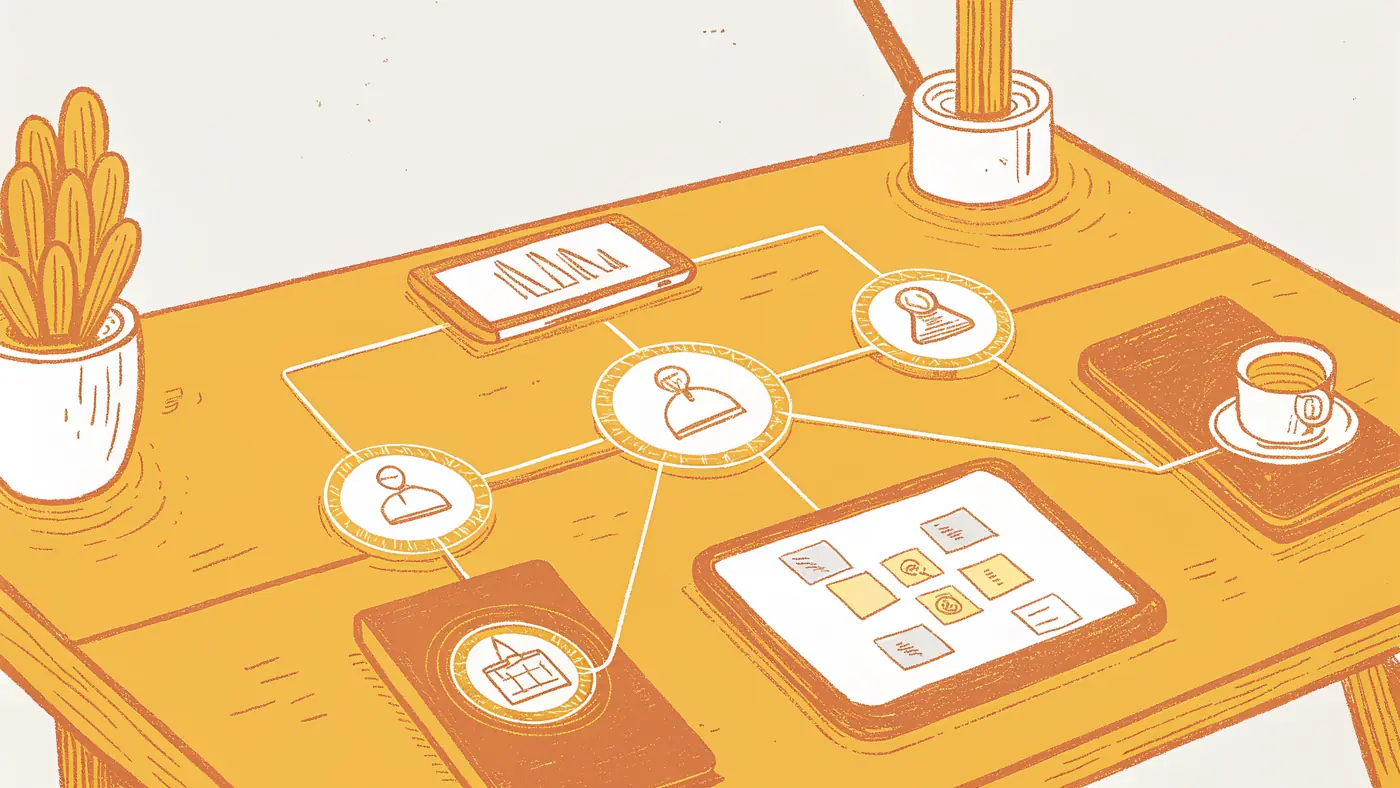
Most AI deployments start at the task level, and the vocabulary hasn’t kept pace with what coordinated systems can now do. See our AI Employees for how this works in practice.
A single agent answers questions. A workforce executes across functions. The difference is coordination. According to the Deloitte AI Institute’s 2025 State of AI in the Enterprise report, only 25% of enterprises report that more than half of their AI use cases involve agentic systems where agents act autonomously and hand tasks to one another. The majority of organizations are still operating a collection of disconnected tools, each requiring a human to carry context between them. That human-as-bridge is exactly where the bottleneck lives.
25% of enterprises report that more than half of their AI use
Agentic AI represents a shift from single-task tools to systems that plan, act, and collaborate across business functions. In practice, a sales agent qualifies a lead, passes structured context to an ops agent, which triggers a finance agent to prepare a cost model, all without a manager restarting the chain. Platforms like Skydive are built on exactly this architecture, with a coordinated set of agents carrying work across sales, ops, and finance without requiring a human to restart the chain at each handoff.
Key takeaways
- The AI workforce is not a single chatbot, it’s a coordinated system of agents that hand work off to each other across functions without a human initiating each step.
- Two things are happening at once: AI agents are replacing discrete tasks inside orgs, and the labor market is splitting into roles that orchestrate AI and roles that compete with it.
- Entry-level hiring floors have quietly risen, candidates who can’t orchestrate AI workflows or interpret model outputs now compete against those who can, at every level.
- The safe/at-risk job binary is wrong. Survival correlates with how much irreplaceable judgment, orchestration, or relational trust a role demands daily, not its title or seniority.
- Flatter orgs don’t mean lighter workloads. When management layers come out, the coordination work those layers owned has to go somewhere, and most teams haven’t answered where.
- Most AI workforce initiatives fail not from lack of ambition but from treating deployment as a series of disconnected tool purchases instead of a single coordinated architecture.
- Skydive closes that gap by letting teams deploy AI teammates that handle real work inside Slack, email, iMessage, and web chat, no engineering team required, no new interface to adopt.
The Two-Track Labor Market AI Is Creating: and Why Both Tracks Matter to Your Org
The common assumption is that scaling output means scaling the team; there’s no other way to get more work done across more functions without adding more people. That assumption is now being tested in real time. The split forming inside your org right now is not theoretical. It is showing up in your next hiring decision, in the roles you are trying to backfill, and in the execution work that keeps falling through the gaps between tools and people.

What the PwC 2026 Global AI Jobs Barometer Reveals About the Split Forming Inside Every Org
AI is creating a two-track labor market. According to the PwC 2026 Global AI Jobs Barometer, one track consists of professionalised roles, where AI amplifies human judgment, strategic thinking, and leadership. The other consists of democratised roles, where AI lowers the technical barrier to execution work, making that work faster to produce and, as a direct consequence, less valuable to pay for. The Barometer is describing what is already visible in headcount data and wage trends across industries today.
Professionalised Roles, Why AI Amplifies Human Judgment Instead of Replacing It
The professionalised track rewards the work AI cannot do alone: contextual judgment, cross-functional orchestration, and decisions that carry real stakes. A financial analyst who can interpret AI-generated models and translate them into board-level recommendations is worth more than before AI arrived. The PwC Barometer puts hard numbers on this: professionalised roles are seeing 42% faster wage growth compared to democratised roles, and headcount in these roles is growing twice as fast. Companies most able to deploy AI are growing headcount and wages measurably faster than their least AI-exposed counterparts.
That divergence reflects a genuine market repricing of judgment.
Democratised Roles, How AI Lowers the Technical Barrier to Execution Work
On the other track, AI is collapsing the skill floor required to perform execution roles. Data entry, basic analysis, administrative drafting, and templated communication no longer require a trained specialist. A single experienced operator with the right AI tools can now cover what previously required two or three junior hires. The result is steady compression of wages and hiring volume in roles that used to represent the operational core of a growing team.
This compression is already underway.
How AI Is Changing Entry-Level Job Requirements: and Raising the Floor for Everyone
Hiring managers have quietly raised the floor. What used to count as a solid entry-level candidate, organized, trainable, willing to do the work, now competes against candidates who can orchestrate AI workflows, interpret model outputs, and make judgment calls that once sat two levels up the org chart. The ramp into professional work did not disappear. It got steeper and shorter at the same time.
“Employers are demanding excessive qualifications for entry-level jobs, effectively raising the baseline bar for new workforce entrants beyond what the roles traditionally required.”
AI-Exposed Junior Roles, What the Market Is Showing
The numbers are hard to argue with. Across the market, junior roles in AI-exposed occupations are now seven times more likely to require traditionally senior skills like judgment and leadership compared to the least AI-exposed junior roles. That figure reflects job postings already live in the market. The same research found that over one third of young workers globally face high exposure to AI-driven task changes, and that employment for workers aged 22 to 25 in highly AI-exposed occupations has already declined by 13 percent.
This is what analysts are calling seniorization: junior roles mutating to carry expectations previously reserved for senior workers. It is structural evidence that the execution layer those roles were built around has already been absorbed.
Skill Change Rate, AI-Exposed vs. Least AI-Exposed Jobs
Skills needed for AI-exposed roles are changing significantly faster than for the least AI-exposed jobs, and broader hiring data consistently confirms that gap is widening every quarter that AI tooling matures. A junior hire who joined eighteen months ago with solid fundamentals may already be working against a skills profile that has shifted underneath them, without any formal retraining to bridge it. The skills needed for AI-exposed roles are documented in occupational research that tracks exactly this kind of accelerating divergence.
AI Fluency Beyond Engineering
AI fluency requirements have diffused well beyond technical roles, now reaching knowledge workers across a broad range of functions, a pattern the World Economic Forum has highlighted as one of the defining workforce shifts of this decade. Product managers are now expected to specify AI agent behavior as part of standard job scope. Marketing associates are building and managing AI-assisted campaign workflows that previously required a five-year senior manager. Financial analysts are being asked to validate and interpret model outputs, not just run queries. The PwC AI Jobs Barometer signals that this diffusion is accelerating, not leveling off.
Which Roles and Skills Are Seeing Increased Demand: and the AI-Adjacent Jobs Growing Fastest
Sorting jobs into “safe” and “at risk” columns feels productive. It isn’t. The actual dividing line runs through something harder to see on an org chart: how much judgment, orchestration, or relational trust a role requires on a daily basis.

The Survival Principle - Judgment, Orchestration, and Relational Trust
Job survival correlates with how much irreplaceable human judgment a role demands. A compliance officer whose role expands because AI agents require human sign-off on high-stakes decisions is safer than a mid-level analyst whose entire workflow is rules-based pattern matching. The principle is simple: the harder it is to specify a decision in advance, the harder it is to automate it.
One of the clearest struggles we see among professionals navigating this shift is the difficulty of knowing which roles are genuinely AI-resilient versus which are being marketed as “AI-proof.” That uncertainty makes career planning feel like guesswork. The honest answer is that resilience lives in the work itself, specifically in whether the work requires someone to weigh competing priorities, maintain trust across relationships, or coordinate systems that don’t talk to each other cleanly. Those are not capabilities an AI agent deploys autonomously; they are the bottleneck that keeps humans in the loop.
Mid-Career Professionals Ages 35 to 50 - The Premium Explained
Mid-career professionals are commanding a measurable wage premium precisely because they carry the two things AI agents cannot yet replicate at scale: contextual judgment built over years, and the relational credibility to act on it. Indeed Hiring Lab’s January labor market update confirms that job postings mentioning AI are growing even as broader hiring volumes remain weak, a pattern that reflects how much organizations are paying above-band for professionals who can supervise AI outputs, catch errors before they compound, and translate between technical teams and business stakeholders.
This is a structural advantage. Orchestration, coordinating complex, multi-step workflows without losing track of who owns what at each stage, and reducing the back-and-forth communication overhead that drains teams, is exactly where experienced professionals are proving their value. The professionals who survive and advance are the ones who can make those coordination functions faster and more reliable.
Which AI-Adjacent Roles Are Growing Fastest, and What the Growth Rate Actually Signals
Prompt Engineers, AI Ethics Specialists, and AI UX Designers are the clearest examples of roles that did not exist as formal job categories five years ago and are now appearing on Indeed as searchable, employer-verified positions. According to the Indeed Hiring Lab’s January labor market update, job postings mentioning AI are growing even as broader hiring volumes remain weak.
The picture on the ground is more complicated than the headline suggests. A growing share of active job listings now require AI-related responsibilities or are oriented toward AI training, including roles in traditionally human-centered fields like editorial, experiential design, and cultural institutions. That shift is real, and it has created a specific challenge for people transitioning into Applied AI and Automation roles: a mixed background spanning engineering, operations, teaching, and self-built AI projects does not map cleanly onto job descriptions that are themselves still loosely defined.
Recruiters see an unconventional résumé; the candidate has relevant experience but no standard label for it.
Hays workforce trends data reflects a similar pattern, with hiring managers struggling to evaluate candidates whose skills cross traditional role boundaries. That growth signal deserves an honest read. The surge in AI-adjacent hiring is partly a transitional dependency: organizations are hiring humans to build and manage AI systems because they lack the infrastructure to deploy agents without engineering resources. Once that infrastructure barrier falls, some of those transitional roles will consolidate or contract, which is worth knowing before treating every AI-adjacent job posting on Indeed as a reliable signal of long-term demand. The roles with staying power are the ones anchored in judgment, orchestration, and relational trust, not the ones defined primarily by proximity to the technology itself.
How AI Is Reshaping Organizational Structures - Flatter Orgs, Fewer Managers, and the Recruitment Paradox
Removing a management layer feels like progress. The org chart shrinks, the payroll line moves, and the quarterly business review looks cleaner. But the work that layer was doing does not disappear with it.
Gartner’s 20% Prediction - Already Happening, Not as Planned
AI is actively flattening organizational structures. According to Gartner Predicts 2026: AI Agents Will Reshape Infrastructure & Operations, AI agents will handle coordination tasks previously owned by middle management, leading 20% of organizations to reduce management layers by 2026. LinkedIn data cited by Gordon L. from early 2026 reinforces this: job postings with “manager” in the title dropped 12% year over year, while “lead” and “principal” roles grew 18%. Technology, financial services, and digital-native sectors are moving considerably faster than manufacturing or healthcare. The flattening is real. The problem is that most orgs are executing the cut before they have solved the coordination problem underneath it.
What makes this harder than it looks: AI acceleration does not eliminate bottlenecks, it moves them. Engineering velocity climbs, and suddenly Product and Design become the constraint. Bug rates tick upward. The org structure problem does not disappear; it migrates. And when the people who carried institutional knowledge in their heads exit alongside the management layer, entire bodies of work get lost or have to be rebuilt from scratch, a direct tax on every team left behind.
What Middle Management Actually Did
Middle managers were, functionally, routing infrastructure. They translated strategic intent into operational tasks, tracked status across functions, and owned the handoffs that kept work moving between teams. That translation and sense-making function does not automate itself just because the title disappears. Industry analysis named this directly: organizations that flatten without redistributing those capabilities risk creating an “alignment vacuum” where strategic intent never reaches execution.
The deeper issue is that much of what middle management did was never written down. Status lived in someone’s inbox. Decision logic lived in someone’s head. When that person leaves, voluntarily or as part of a restructuring, teams find themselves redoing projects from scratch because the context was never persisted anywhere a successor could find it. That is a structural problem, and it does not get solved by org chart surgery alone.
BCG’s Finding - Redesign Outperforms Downsizing
Boston Consulting Group’s research on AI organizational structure distinguishes between companies that simply reduce headcount and those that redesign workflows around AI agent infrastructure. The firms that redesign consistently outperform on productivity and operating leverage. The difference is whether the coordination function was rebuilt before the human layer carrying it was removed.
Skydive is built around exactly that sequencing. Its multi-teammate architecture means complex, multi-step workflows can be coordinated across a team without losing track of who owns what at each stage, with routing, escalation, and status visibility handled persistently, not tucked into someone’s calendar or Slack thread. Memory and persistence mean institutional knowledge does not evaporate when a person exits; it stays accessible to whoever picks up the work next.
Granular permissions and team collaboration controls let organizations define precisely which decisions a teammate can own autonomously and which surface for human judgment, the exact design question that separates productive flattening from operational chaos. The result is a genuine step-change in operating org productivity: the coordination layer is rebuilt in the platform before the human carrying it is removed.
Structural Reorganization, Not Mass Displacement
The real mechanism here is redesign, not elimination. A 50-person startup that deploys agents to route, summarize, and escalate work automatically, before removing an ops management layer, gains genuine operating leverage. One that cuts the layer first inherits the chaos.
Skydive’s scheduled runs, built-in tools, and pre-built teammate templates mean that infrastructure can be stood up before the restructuring happens, not patched together after. Multi-channel access keeps teammates reachable across the surfaces a team already works in, reducing the back-and-forth communication overhead that eats the hours middle managers used to absorb. Worth naming the honest trade-off: this approach requires upfront investment in defining which decisions agents can own and which need human judgment.
That design work is the leverage point, and it is precisely where starting with the right infrastructure makes the difference between a leaner org and a broken one.
Related Reading
- The Complete Guide to AI Agent Infrastructure & Components
- Make vs n8n: Which Automation Tool Wins in 2026?
- 13 Best Lindy AI Alternatives for Smarter Automation 2026
- Gumloop vs n8n: Which Automation Tool Should You Choose?
- 13 Best AI Agent Builders in 2026
- Multi Agent Orchestration Explained: What It Is and How It Works
Types of AI Agents in the Workplace: and How They Hand Work Off to Each Other
The classification of AI agents looks like an engineering problem until a workflow breaks at 2 a.m. and no one can tell which system made the call that triggered the cascade. That is when agent type stops being taxonomy and starts being accountability structure. Across the market, the defining feature separating a multi-agent AI workforce from a collection of individual tools is autonomous cross-functional handoff: agents passing context and work to each other across sales, operations, and finance without a human re-initiating each step. The type of agent you place in a given function determines whether that handoff is clean, auditable, and self-correcting, or whether errors compound silently across connected systems before anyone notices.
Skydive is built on this principle from the ground up. Its architecture is multi-teammate by default, meaning the system is designed around agents that coordinate with each other, not around a single agent you bolt others onto later. Every teammate runs in its own per-teammate sandbox with browser access, operates across multiple channels, and carries memory and persistence across sessions. Granular permissions and team collaboration controls mean you can define exactly which teammate owns what, so when a handoff happens, accountability travels with it.
1. Reactive AI Agents - The Always-Ready Responders That Trigger on Demand
Reactive agents respond when prompted. A sales rep asks for a competitor summary; the agent returns one. A support ticket arrives; the agent drafts a reply. The strength here is precision and control: the human initiates, the agent executes, and the loop closes. The real tradeoff is that reactive agents are only as useful as the person who remembers to ask. They do not catch the compliance flag you did not know to look for, and they do not move work forward while your team is focused elsewhere.
Where reactive agents deliver outsized value is in reclaiming the work that never should have been on your plate in the first place. The teams we work with at Skydive describe a familiar pattern: hours that should go to writing, positioning, and strategic judgment get consumed by information-retrieval tasks that feel important in the moment but are fundamentally delegable. Skydive’s pre-built teammate templates give you reactive agents that are ready to field those requests from day one, so you hand off the lookup, the draft, the summary to something competent without waiting months to hire, and preserve your calendar for the work only you can do.
2. Proactive AI Agents - The Background Monitors That Act Before You Ask
Proactive agents run continuously, scanning for conditions that trigger action without waiting for a prompt. Growing enterprise deployment in compliance monitoring, inventory anomaly detection, and pipeline risk flagging reflects the cost of a missed signal in those functions: errors compound before any human would have thought to check. The limitation is trust calibration: a proactive agent acting on a false positive in a procurement or compliance context can create more work than it saves. Threshold-setting and escalation rules are not optional configuration; they are the actual design work.
3. Orchestrator Agents - The Workflow Directors That Route Tasks Across Specialist Agents
Orchestrator agents decompose complex tasks and route subtasks to specialist agents, then reassemble outputs into a completed workflow. This is the architecture that allows a single inbound event, a new enterprise lead, a supplier delay, a failed payment, to trigger coordinated action across multiple functions without human re-initiation at each step. A well-established principle in multi-agent orchestration architecture holds that the protocols governing how agents hand off context to each other are as consequential as the capabilities of the agents themselves; a brittle handoff protocol is where cascading failures originate.
The honest tradeoff: orchestration logic can itself become a bottleneck. Debugging a failure across a chain of agents is measurably harder than debugging a single-agent error, which means audit trails and explainability logging are not nice-to-haves in an orchestrated system, they are the operational foundation that makes the whole chain trustworthy.
Skydive addresses this directly. Because the platform is multi-teammate by default, orchestration is a first-class design concern rather than an afterthought. MCP (Model Context Protocol) support means teammates share context through a structured protocol, not ad-hoc integrations that break silently. Granular permissions define ownership at each stage of a workflow, so when you need to trace which teammate made the call that triggered a downstream action, the accountability structure is already there, not something you reconstruct after the fact. The teams we work with use this to coordinate complex, multi-step workflows without losing track of who owns what at each stage, handing off work across functions to something competent while preserving their own time for the strategic judgment that no agent should be making for them.
4. Specialist Domain Agents - The Deep-Skill Executors Handed Off to by Orchestrators
Specialist agents are purpose-built for a single domain, finance reconciliation, clinical documentation, or data pipeline management, and receive work packages handed off from orchestrators or reactive front-end agents. They excel when depth of capability matters more than breadth, delivering higher accuracy than generalist models on narrow tasks. The limitation is rigidity: they require significant re-engineering when business processes shift, and they can’t self-redirect if the task scope changes mid-execution.
5. Autonomous CRM Agents - The End-to-End Resolution Agents That Close Loops Without Handoffs
Autonomous CRM agents represent the most integrated tier of the AI workforce, handling full customer lifecycle actions, rerouting shipments, updating billing, notifying warehouses, and logging audit trails, within a single interaction and without escalating to a human queue. They’re the right fit for organizations with mature data infrastructure and well-defined process boundaries. The critical tradeoff is trust and liability: autonomous resolution at this level requires robust exception-handling protocols, since errors compound across multiple systems before any human reviews them.
Building an Effective AI Workforce - Steps, Tools, and What Most Teams Get Wrong
Most AI workforce initiatives collapse the same way: not from lack of ambition, but from treating implementation as a series of tool purchases rather than a single, coordinated architecture question. The browser tabs accumulate, nobody opens them, and the initiative quietly dies. That pattern is not accidental, and it is exactly the failure mode Skydive is built to interrupt.

Finding the Seams Where Context Dies
The failure point is almost never the AI itself. It is the gap between systems, the moment a Slack thread ends and someone has to manually carry its context into a spreadsheet, then into an email, then into a CRM. Knowledge workers now juggle an average of more than a dozen SaaS applications daily, and every boundary between those apps is a place where judgment, history, and intent get dropped.
One pattern that surfaces repeatedly among teams beginning their AI implementation is that there are no thorough, comprehensive policies covering real-world handoff scenarios, leaving critical governance gaps precisely where context transfer matters most. When no one has written down who owns context at each seam, no tool can fill that void automatically.
Mapping those seams, literally drawing the handoff chain, is the first act of any serious AI workforce strategy. Skydive’s multi-teammate architecture makes this concrete: each teammate is scoped with granular permissions and operates inside a per-teammate sandbox with browser access, so you can assign clear ownership at every node in the chain before a single workflow goes live. The goal is to coordinate your team through complex, multi-step workflows without losing track of who owns what at each stage, and that starts with knowing where the seams are.
Delegating Judgment vs. Keeping It Human
Not every decision is a candidate for delegation. Routine, rules-based judgment, the kind your best operator has already systematized in their head, transfers well. Consequential, relationship-sensitive, or legally significant calls do not. Getting this wrong in either direction costs you: over-delegating erodes trust, and under-delegating means your agents are just expensive note-takers.
This is also where governance gaps bite hardest. Teams implementing AI without thorough policies covering real-world use cases tend to discover the boundary between delegable and non-delegable judgment only after something goes wrong. Building that boundary into the system explicitly, through Skydive’s granular permissions and team collaboration controls, means the architecture enforces the judgment split rather than relying on individual operators to remember it under pressure.
Deploy Agents Where Work Already Lives
According to an MIT report (as reported by Fortune), 95% of generative AI pilots are failing, and the primary culprit is deployment friction, not weak technology. Separate research from NTT DATA puts the failure rate for generative AI deployment efforts at between 70 and 85 percent, arriving at the same root cause: teams required to leave existing tools for a new interface rarely make the switch at the adoption rates pilots assume.
Pilots collapse when they require workers to migrate to a new interface rather than embedding into email, Slack, or the tools where work already happens. A 30-person ops team that deploys an agent inside their existing Slack-to-spreadsheet handoff loop will see adoption. One that asks the team to log into a separate portal will not.
Skydive is multi-channel by default; teammates reach workers through the surfaces where work is already happening, not through a dashboard that requires a behavior change to unlock value. Combined with MCP (Model Context Protocol) support and built-in tools and capabilities, agents can connect to the systems your team already relies on rather than sitting alongside them. That is how you get real output from AI tools, not suggestions, and get back a day this week instead of spending it onboarding a platform nobody will use next month.
Human-in-the-Loop Checkpoints for High-Stakes Outputs
Autonomous execution is the goal. Unchecked autonomous execution is the risk.
Before any agent ships a contract, sends a client-facing message, or triggers a financial workflow, a human checkpoint should exist, not as a permanent fixture, but as a calibration gate you remove only after the agent has earned it through a track record of accurate outputs. Skydive’s memory and persistence layer means agents carry a running track record: prior decisions, outputs, and corrections accumulate so that calibration is based on evidence rather than gut feel. Scheduled runs and pre-built teammate templates let teams stage autonomous execution gradually, starting with assisted drafts, moving to reviewed outputs, and eventually to fully autonomous steps only where the agent has demonstrated it.
The back-and-forth communication overhead of manually chasing approval on every output is reduced without removing the human judgment that matters.
The Real Reason AI Workforce Initiatives Fail, and How to Avoid It
The failure mode is almost always the same: teams buy tools in parallel, each solving a local problem, and never ask whether the outputs of one tool are legible to the next. The result is a patchwork of capable components that cannot hand work to each other, which means a human still has to carry context between them. The AI sits at the edge of the workflow instead of running through the middle of it. This is compounded when there are no comprehensive policies governing how those tools interact, leaving governance gaps that only become visible when something breaks.
The fix is treating the handoff layer as the product: designing explicitly for how context, status, and decisions move between agents before choosing which platform handles each function. Skydive’s multi-teammate architecture, built from a description, coordinating across channels, with memory and persistence threading context from one step to the next, is designed around that handoff layer, not bolted onto it afterward. That is how you stop trialing tools that don’t stick and start running AI through the middle of the work, where it can change what your team produces.
Preparing for the Future of AI Work - What the Org Looks Like When the AI Workforce Is Running
Most organizations treating AI as a productivity layer are missing the structural question: what does the org actually look like when agents are running continuously across every function? This section works through that question directly, covering how reporting structures change, why preserving institutional judgment inside persistent agents matters more than headcount math, and where a COO or operator should start to get compounding value moving without a transformation program.

What the Operating Org Looks Like When AI Agents Run Across Every Function
The org that has genuinely deployed an AI workforce looks structurally different, not just faster. Reporting layers thin out because agents absorb the coordination work that middle management previously owned. A COO running three functions without three function heads is the logical outcome when agents persist across tools, carry context between handoffs, and surface decisions rather than create them.
Why Preserving Human Judgment Is the Missing Layer in Any AI Workforce Rollout
Turnover doesn’t just cost money. It destroys the judgment that took years to build.
The real loss is the encoded decision-making that walks out with the person. Persistent AI agents convert that recurring loss into a one-time configuration cost that compounds in value instead of resetting every time someone gets promoted or leaves.
Organizations that have encoded their core workflows into persistent agents often report that onboarding a replacement hire becomes significantly faster, because the institutional logic that used to live in one person’s head is already running in the system.
The COO Entry Point
The fastest path to compounding is one cross-functional handoff: the moment an agent passes context from sales to ops without a human re-initiating the thread. That single handoff, running continuously, surfaces the structural benefit faster than any siloed automation. Most COOs arrive here and then face the real hidden cost: architecting, maintaining, and re-engineering every agent when a process changes. Teams using AI Employees describe the teammate in plain language and the agent is configured from that description, no workflow builder, no code, and no engineering queue standing between the business decision and the deployed system.
That said, this approach is a poor fit for organizations with 100 or more people who already have established offshore or BPO contracts in place, for heavily regulated environments like healthcare providers or federal-adjacent government, or for any company whose primary customer acquisition motion runs entirely through a direct sales team, the coordination leverage AI agents deliver does not translate cleanly into those operating models.
Related Reading
- Lindy vs Zapier: Which Automation Tool Wins in 2026?
- 13 Best Relevance AI Alternatives for Building AI Agents 2026
- How to Master AI Agent Prompt Engineering in 2026
- 15 Best Gumloop Alternatives for AI Automation in 2026
- How to Build a Multi Agent Workflow That Actually Scales
- Types of AI Agent Pricing Models (And How to Choose)
Next steps
If your team’s output is bottlenecked by how fast you can hire, the path forward starts with treating coordination as infrastructure, not headcount.
The seniorization of entry-level roles confirms that execution work has already been absorbed, meaning adding junior headcount no longer buys throughput. The 95% failure rate of enterprise AI pilots traces back to deployment architecture, not technology, with pilots collapsing the moment they require workers to leave the tools they already use. Together, those two findings point to the same action: deploying agents inside existing workflows, not alongside them, so coordination runs continuously without a human restarting the chain at every handoff.
Start by exploring AI Employees from Skydive. Describe the role you need filled, and a teammate is configured from that description, running across the channels your team already uses, no engineering queue required.
Frequently Asked Questions
Which jobs are most exposed to AI replacement?
Roles built around rules-based, execution-heavy tasks are most exposed, things like data entry, basic analysis, administrative drafting, and templated communication. The post is specific: employment for workers aged 22 to 25 in highly AI-exposed occupations has already declined by 13 percent, and firms are reporting they are not replacing departing junior staff. The dividing line is how much irreplaceable judgment, orchestration, or relational trust a role demands on a daily basis, the harder it is to specify a decision in advance, the harder it is to automate it.
What actually is a multi-agent system, and how is it different from a regular AI tool?
A single AI tool handles one task and then stops, a human has to pick up the result and hand it to the next tool or person. A multi-agent system keeps work moving on its own: one agent qualifies a lead, passes structured context to an ops agent, which triggers a finance agent to prepare a cost model, all without a manager restarting the chain at each handoff. The post puts the adoption gap in numbers: only 25% of enterprises report that more than half of their AI use cases involve agentic systems where agents act autonomously and hand tasks to one another.
If AI is doing more of the work, why are some companies actually growing headcount faster?
Companies most able to deploy AI are growing headcount and wages measurably faster than their least AI-exposed counterparts, according to the PwC 2026 Global AI Jobs Barometer. The growth is concentrated in professionalised roles, positions where AI amplifies human judgment, strategic thinking, and leadership rather than replacing them. Those roles are seeing 42% faster wage growth and headcount growing twice as fast compared to democratised, execution-focused roles.
Should my company flatten its org structure and cut management layers because of AI?
Not without first solving the coordination problem underneath it. The post warns that AI does not eliminate bottlenecks, it moves them, and when a management layer is removed, the routing and translation work those managers did does not disappear with their titles. Middle managers were functionally routing infrastructure: translating strategy into tasks, tracking status across functions, and owning handoffs. Organizations that flatten without redistributing those capabilities risk creating an alignment vacuum where strategic intent never reaches execution.
Are entry-level jobs just harder to get now, or has something more structural changed?
It is structural. Junior roles in AI-exposed occupations are now seven times more likely to require traditionally senior skills like judgment and leadership compared to the least AI-exposed junior roles, and that figure reflects job postings already live in the market, not projections. The post calls this “seniorization”: junior roles mutating to carry expectations previously reserved for senior workers because the execution layer those roles were built around has already been absorbed by AI tools.