12 Best AI Automation for Sales Tools That Actually Work
AI automation for sales tools GTM leaders actually keep past week two, ranked by how much selling time and revenue they recover per rep.
 Skydive 25 min read

Table of contents
Most sales teams aren’t stuck on the wrong tool. They’re stuck on the wrong assumption. Here’s why single-platform AI implementations stall, and what full-funnel automation actually requires.
AI sales automation uses artificial intelligence and machine learning to handle repetitive sales tasks, specifically the low-judgment, high-volume work that consumes a rep’s day before they ever touch a real conversation. The common assumption among most heads of GTM, growth, and VP Growths is that if they find the right single AI sales tool with enough integrations and workflow triggers, it will finally automate enough of their process to matter. The harder question is why, after years of tool investment, most GTM teams are still doing that work themselves.
“Sales teams hit scaling limits due to hiring budget constraints, forcing leaders to seek AI automation as a substitute for headcount, a reactive rather than strategic adoption pattern that often leads to stalled implementations.” See our AI teammates for how this works in practice.

AI sales automation is the application of machine learning and rules-based logic to tasks like lead qualification and routing, CRM updates, follow-up sequencing, and outreach personalization. A rep who receives GPT-generated email drafts but still manually decides who gets them, when, and what happens next is experiencing assisted typing. Most tools stop at assistance and call it automation.
A rep who receives GPT-generated email drafts but still manually decides who gets them, when, and what happens next is not experiencing automation. They are experiencing assisted typing.
The repetition tax is real and measurable. The majority of a sales rep’s week is consumed by administrative work, CRM updates, research, follow-up drafting, and proposal assembly, rather than actual selling. Top-performing teams that address this non-selling time can recover five to eight extra selling weeks per year, per rep.
60% of reps’ time lost to non-selling tasks
CRM data quality is where the tax compounds quietly. Manual entry is inconsistent by nature.
Reps log what they remember, when they remember it, and the pipeline data that leadership relies on for forecasting reflects that inconsistency directly. Adding more point solutions makes it worse. Salesmotion’s research notes that each new tool creates additional context-switching and manual assembly work rather than eliminating it.
The stack grows; the problem compounds.
The stall is structural. Most single-agent tools arrive capable and empty. Lead qualification and routing logic, CRM write-back rules, and follow-up triggers all still have to be wired by a human. The GTM leader becomes the engineer, and the automation that was supposed to free the team ends up depending entirely on that leader to keep it running.
Key takeaways
- Most AI sales automation stalls not because the tool is wrong, but because one agent can’t cover five funnel stages with five different success signals and five different data sources.
- The teams reporting real lift from AI in sales aren’t using a single platform with more integrations, they’re running coordinated, specialized agents that each own a defined scope.
- Faster lead response is the benefit that shows up in revenue first, every minute of delay before a reply is a minute a competitor can use.
- Counting features on a comparison table is a distraction; the only filter that matters is whether the tool produces finished output or hands you a canvas and waits.
- Adding tools doesn’t reliably produce output, the average company runs 130-plus SaaS applications with low adoption rates relative to licenses purchased.
- SkyDive closes the gap with multi-teammate by default: each teammate carries its own identity, scope, and history, and hands off to the next without anyone mapping the steps in advance.
Core Use Cases for AI Sales Automation - Across the Full Funnel
Five funnel stages. Five different success signals. Five different data sources. That’s the structural reality most buyers discover only after they’ve already signed a contract for a single platform that promised to cover everything. The common assumption among most heads of GTM, growth, and VP Growths is: “If I find the right single AI sales tool with enough integrations and workflow triggers, it will finally automate enough of my process to matter.” That assumption is exactly what vendors are selling against, and exactly what the funnel’s structure disproves.

The Five Funnel Stages Where AI Automation Actually Earns Its Keep
The core use cases for AI sales automation are:
- Prospecting and lead scoring
- Automated Personalized Follow-Ups
- CRM data hygiene
- Proposal Generation
- Conversation intelligence
Each stage has a distinct input, a distinct output, and a distinct failure mode when the wrong tool handles it. Lead scoring automation runs on behavioral signals; conversation intelligence runs on call transcripts. These are not the same problem, and they rarely share a best-in-class solution.
What makes this harder in practice: even sales professionals who are genuinely strong at client acquisition and funnel strategy routinely struggle to execute cold email lead generation effectively on their own. The gap between top-of-funnel outreach and mid- and bottom-funnel conversion is an execution gap. Knowing what great cold outreach looks like and being able to run it consistently, at volume, while managing everything else in the funnel are two different things. SkyDive is built to close exactly that gap, handling the full GTM motion without requiring teams to build everything from scratch, and doing it across every function without adding headcount.
Automated Personalized Follow-Ups, The Use Case With the Clearest ROI Signal
Automated Personalized Follow-Ups deliver one of the clearest, fastest returns among AI sales automation use cases. The mechanism is straightforward: higher follow-up volume plus context-aware personalization equals more conversions, and AI handles both without adding headcount. The compounding effect shows up in pipeline velocity within weeks, not quarters.
SkyDive’s multi-teammate architecture means follow-up sequences aren’t a single thread that breaks when context shifts. Each teammate can run code and commands, read and write files, browse the web, search the web, host web apps, process media, and give itself new tools as needed, maintaining memory and persistence across interactions so follow-ups carry the right context into every touchpoint. Pre-built teammate templates accelerate deployment, and teammates show up in Slack, email, iMessage, and web chat, the conversation surfaces the team already lives in. iMessage support is novel across the competitive set.
Proposal Generation and CRM Data Hygiene, Where Manual Work Quietly Bleeds Hours
According to Salesmotion, the majority of a sales rep’s week is consumed by non-selling work, CRM updates, research, and administrative tasks, leaving only a fraction of the day for actual selling conversations. AI Proposal Generation compresses hours of template-filling and pricing logic into minutes. CRM write-backs eliminate the manual entry that reps quietly skip, which means pipeline data reflects reality.
Together, these two use cases recover the most recoverable time in any sales org.
SkyDive’s built-in tools and capabilities, combined with MCP (Model Context Protocol) support, allow teammates to connect directly into the systems where proposals are built and CRM records live, as a native part of the workflow rather than a fragile integration. Scheduled runs handle recurring hygiene tasks automatically. Granular permissions and team collaboration controls mean the right teammate owns the right stage, and complex, multi-step workflows don’t lose track of who owns what at each step. The back-and-forth communication overhead that typically follows a proposal draft or a CRM audit gets compressed out of the process entirely, keeping the team focused on selling rather than status updates.
Why Every Use Case Has a Best-in-Class Specialist and Why That’s the Problem
The specialist problem is real. A conversation intelligence tool that excels at surfacing deal risk from call recordings will not match a dedicated prospecting tool’s ability to build and score a cold outbound list, and vice versa. Choosing a single platform to cover both usually means accepting a meaningful capability gap at whichever stage matters most to your motion.
SkyDive’s answer to the specialist problem is a multi-teammate model where specialized teammates coordinate across the full GTM motion through complex, multi-step workflows, each owning a defined stage with the context and permissions appropriate to it. That’s how you get best-in-class execution at each funnel stage without the overhead of managing a disconnected stack of point solutions.
Conversation Intelligence, The Signal Layer That Closes the Loop Between Outreach, and Revenue
Conversation intelligence sits at the bottom of the funnel where the cost of missing a signal is highest. A deal that stalls because a risk indicator surfaced on a call and never made it into the CRM, or never triggered a follow-up, is a data routing problem. The raw material, the call transcript, exists. The insight is derivable. The failure is in the gap between where the signal lives and where the action needs to happen.
SkyDive’s teammate architecture closes that gap structurally. Because teammates can process media, browse and search the web, read and write files, and run multi-step workflows with memory and persistence across interactions, a conversation intelligence teammate does not simply transcribe and summarize. It routes.
A risk signal from a late-stage call can trigger a follow-up sequence, update a CRM record, flag a Slack thread, or escalate to a human, without a rep manually translating the insight into action. The same teammate that surfaces the signal can own the response, across whichever conversation surface the team already operates in. That is the difference between conversation intelligence as a reporting layer and conversation intelligence as an active part of the funnel.
Most platforms stop at the report. SkyDive carries the signal forward into the next action, which is where the revenue impact lives.
12 Best AI Automation for Sales Tools - Ranked and Reviewed
Salesforce’s State of Sales data puts it plainly: sales teams using AI report a significant increase in leads and appointments. That number sounds like vendor copy until you look at where the gain actually comes from. The tools that deliver are the ones that produce output without asking the operator to wire every step between them.
The work most GTM leaders describe spans research, outbound, content, partnerships, and customer conversations. No single agent covers that surface area. So the stack stays duct-taped, the operator stays in the middle, and the AI tools that survived the second week are the ones that stopped asking for manual input on every handoff.
The twelve tools below are ranked not by feature count but by whether they produce real output or hand you a canvas. Each entry names who the tool is built for, what it does well, and the one tradeoff that matters to a GTM leader making a budget decision.
1. SkyDive - Best AI Automation for Sales Teams Using Slack & Email
Most teams evaluating this list will pick one tool, hit the limits of its single-agent scope, and quietly add another, a pattern consistent with the finding that the average company runs 130+ SaaS applications with low adoption rates relative to licenses purchased, until they are managing five separate logins, five separate contexts, and still personally bridging every handoff. SkyDive’s AI teammates solve a different problem: a prospecting teammate, a follow-up teammate, and a deal-tracking teammate operate simultaneously inside Slack or email, each with its own scope and history, handing context to each other without anyone drawing the map between them. Most beneficial when your GTM motion spans more than one channel and you have stopped wanting to be the engineer who maintains the workflow.
2. 11x.ai - Best AI SDR for Autonomous Cold Email at Scale
11x.ai’s Alice is a fully autonomous AI SDR that researches prospects, writes personalized cold emails, and manages follow-up sequences without rep involvement. It targets enterprise teams that want high send volume with minimal human oversight. The real tradeoff in high-volume autonomous outreach is the tension between send scale and reply quality. Personalization at volume tends to flatten the contextual nuance that a human rep applies when responding to a warm signal, which is why teams evaluating AI SDR tools often weigh throughput against reply rate as separate variables rather than assuming they move together. Pricing is enterprise-tier, making it a harder case for teams below fifty seats.
3. AiSDR - Best for Full-Cycle AI Outreach Across Email and LinkedIn
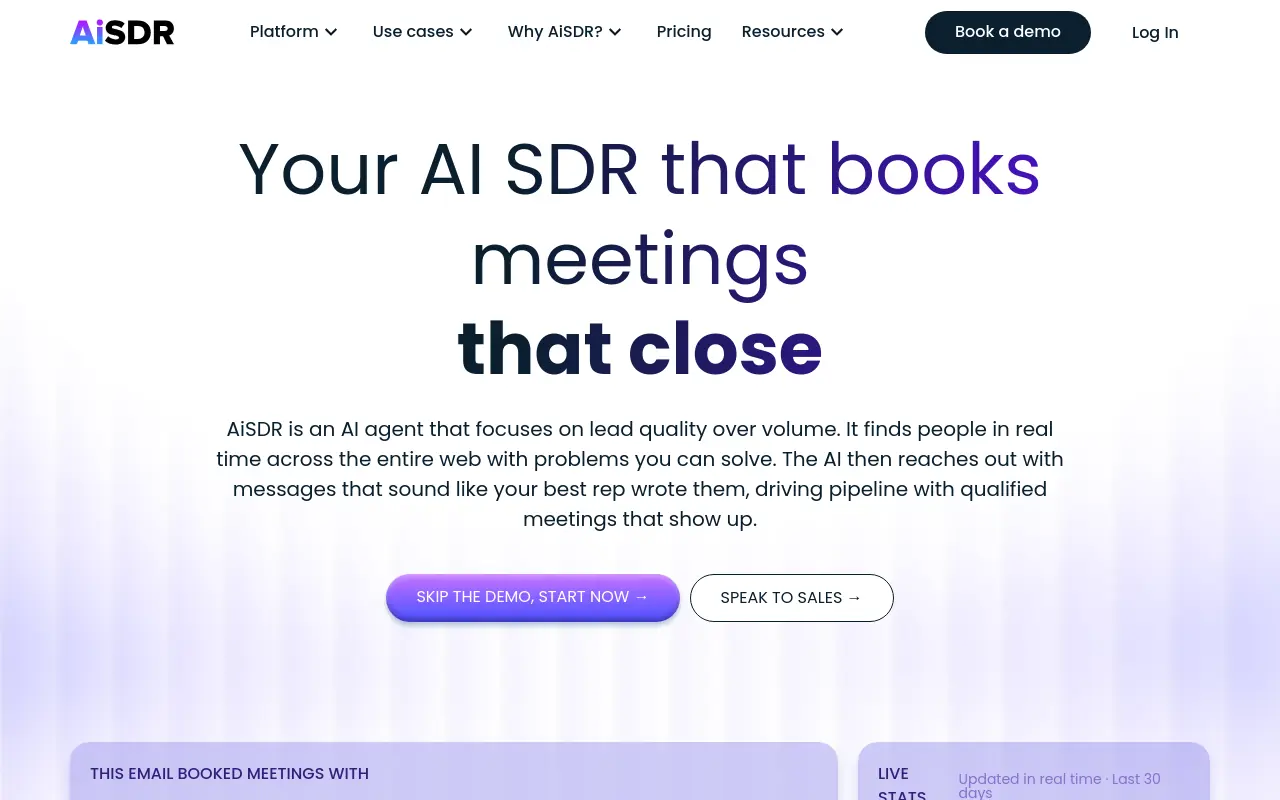 AiSDR handles prospecting, personalized email sequences, and LinkedIn outreach inside a single platform, positioning itself as a full-cycle alternative to stitching together a separate prospecting tool and a separate sequencing tool. It is the right pick when the bottleneck is coverage across both channels without adding headcount. The tradeoff is depth: full-cycle breadth means neither the email engine nor the LinkedIn layer is as specialized as a best-in-class point solution for each. Teams with a defined outbound playbook and high volume requirements will feel that ceiling faster than early-stage teams still building their motion.
4. Pipedrive - Best AI-Augmented CRM for Pipeline Visibility
Pipedrive’s AI layer sits inside a CRM that is genuinely easy to adopt, surfacing deal health signals, next-step suggestions, and pipeline summaries without requiring a Salesforce administrator to configure it. It is the right pick for inside sales teams of ten to fifty who want AI-assisted pipeline management without enterprise overhead. Pipedrive’s own page advertises deeper automation, including automated lead nurturing and automated sales conversations, though most teams will get the most value using it as augmentation on top of a well-maintained pipeline first. According to the Cirrus Insight AI in Sales 2025 Report, AI is most effective when embedded in tools teams already use, and Pipedrive earns that mark, but output quality depends on how consistently reps log activity.
5. Outreach.ai - Best AI Sales Execution Platform for Enterprise Revenue Teams
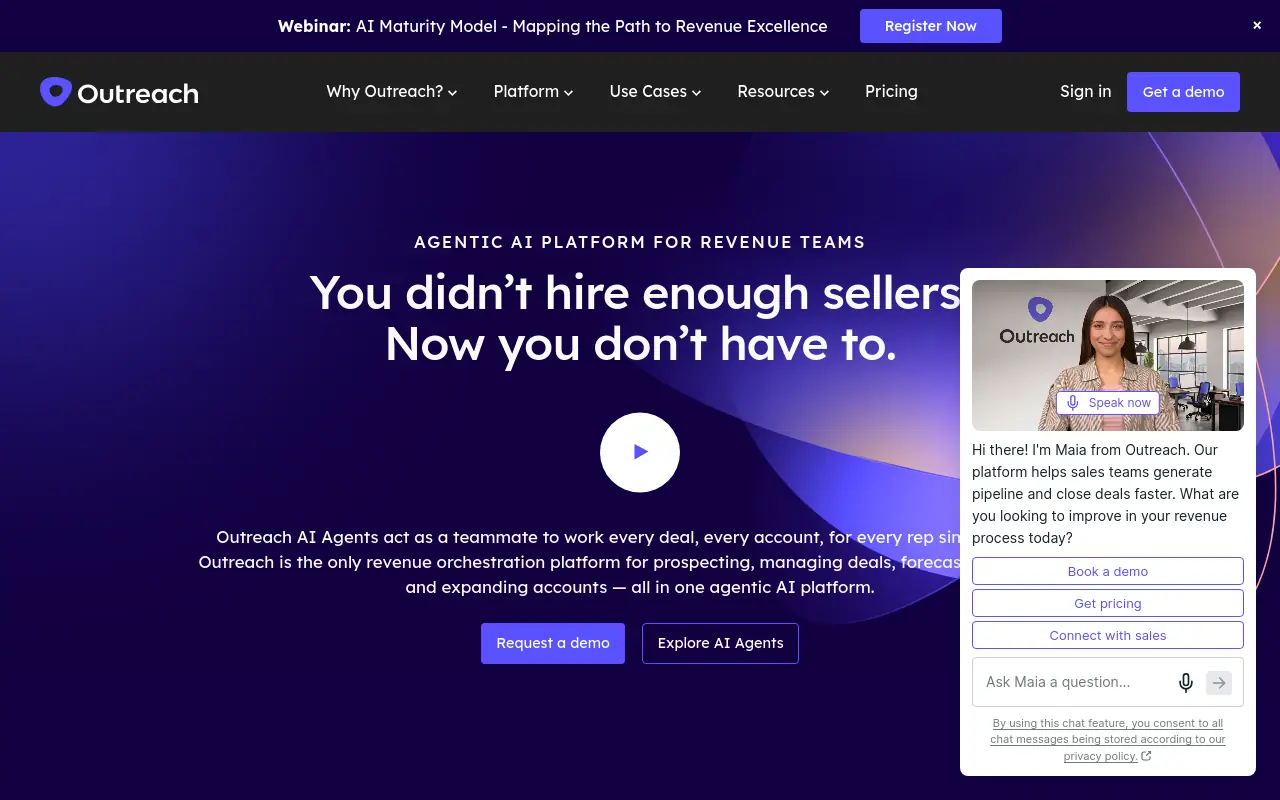 Outreach combines sequence automation, conversation intelligence, and deal inspection inside one platform built for large revenue teams with dedicated RevOps support. The AI layer flags at-risk deals, recommends next actions, and scores rep performance against winning patterns. It is the right pick when you have the team to configure it and the deal volume to train its models. The tradeoff is real: Outreach is an investment in infrastructure. Teams under thirty seats will spend more time on configuration than they recover in output, and the per-seat cost compounds fast at enterprise scale.
6. Amplemarket - Best AI Sales Sequencing Tool for Deliverability-First Teams
Amplemarket’s differentiator is deliverability. Its AI monitors sending reputation, rotates domains, and adjusts cadence timing to protect inbox placement, the variable most sequencing tools ignore until reply rates collapse. It is the right pick for outbound-heavy teams that have already burned a domain or watched open rates fall off a cliff after a high-volume campaign. The tradeoff: Amplemarket’s prospecting database is smaller than Apollo.io’s or ZoomInfo’s, so teams that need both data sourcing and sequencing in one tool will still need a second platform.
7. Coffee.ai - Best AI Sales Automation for CRM Data Hygiene and Follow-Up
The Cirrus Insight AI in Sales 2025 Report confirms what most sales managers already suspect: reps spend a significant portion of their day on non-selling activities like data entry, scheduling, and follow-up, tasks that directly compress selling capacity. Coffee.ai targets that specific leak, automatically writing CRM notes from call recordings, drafting follow-up emails, and syncing activity data without rep input. It is the right pick when CRM hygiene is the bottleneck and pipeline data is unreliable because reps are not logging consistently. Worth noting: Coffee.ai also includes outbound and prospecting-adjacent capabilities, pre-call prospect research, meeting briefings, and follow-up drafting, so teams may not need a separate platform solely for prospecting support.
8. ZoomInfo Sales - Best AI Forecasting Tool for Data-Driven Pipeline Management
ZoomInfo’s AI layer combines its contact and company intelligence database with buying intent signals and pipeline forecasting, giving revenue leaders a signal-rich view of which accounts are in-market before a rep makes contact. It is the right pick for data-driven teams that treat pipeline as a forecasting problem. The tradeoff is cost and complexity: ZoomInfo is one of the more expensive platforms on this list, and extracting value from intent data requires a team that knows how to act on signals quickly. Teams without a defined outbound motion will pay for data they cannot operationalize.
9. Landbot - Best AI Automation for Conversational Lead Qualification on Web
Landbot builds conversational flows that qualify inbound leads in real time, routing high-intent visitors to a rep or booking page without a human in the loop. Across inbound lead scenarios, faster response time is consistently identified as a primary driver of conversion, a pattern that favors tools capable of engaging visitors around the clock without rep availability as a constraint. Landbot is the right pick when inbound volume is high and the qualification step is the bottleneck. The tradeoff: Landbot is a conversation tool, not a CRM or sequencing platform. It captures and qualifies; what happens next depends on how cleanly it connects to the rest of the stack.
10. ChatBot.com - Best AI Sales Automation for 24/7 Lead Capture and Nurture
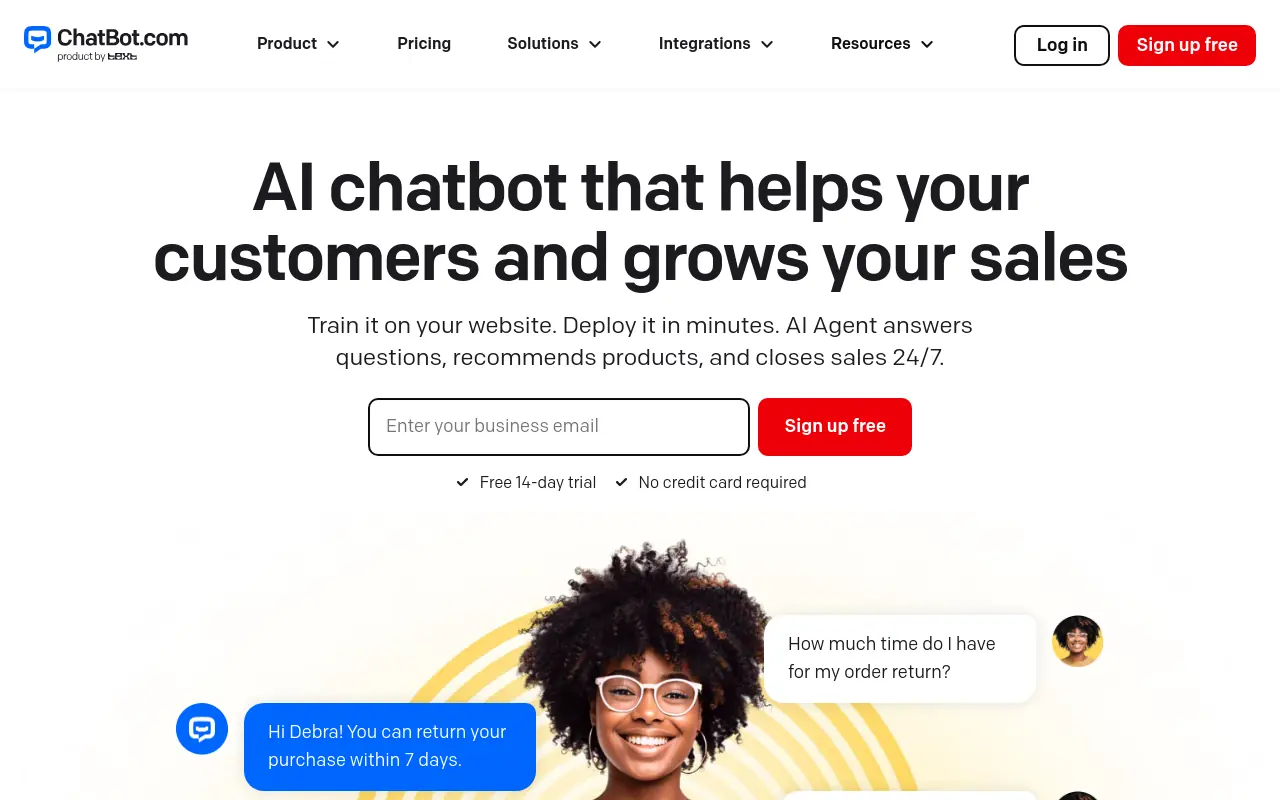 ChatBot.com positions itself primarily as an AI customer service and sales assistant platform, focusing on automated customer support, product recommendations, and closing sales across web and messaging channels 24/7. The 24/7 coverage argument is straightforward: research consistently links response speed to lead conversion, and a prospect who submits a form after hours will move to whichever vendor responds first, human or automated. ChatBot.com is the right pick for teams with significant inbound volume and a clear qualification script.
The honest tradeoff: the platform is strongest when the qualification logic is well-defined and relatively static. Complex, multi-variable qualification scenarios require ongoing prompt and flow maintenance that adds operator overhead.
11. Clari - Best AI Revenue Intelligence Platform for Sales Forecasting Accuracy
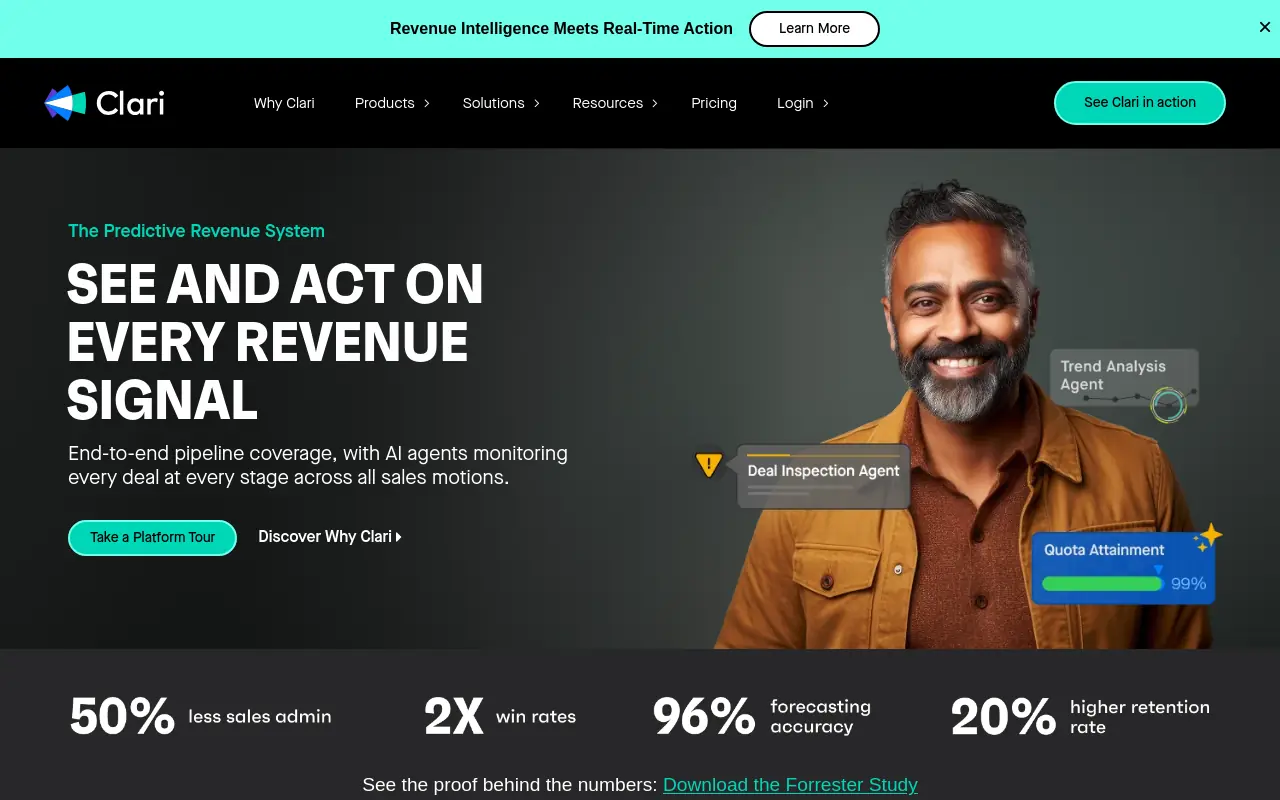 Clari is a purpose-built AI revenue intelligence platform that ingests CRM data, rep activity, and engagement signals to deliver highly accurate sales forecasts and pipeline risk alerts. It’s the strongest choice for VP-level sales leaders and RevOps teams that need board-ready forecast confidence and early warning on at-risk deals. Clari’s AI surfaces which deals are slipping before reps notice. The tradeoff: it’s a reporting and intelligence layer, not an execution tool, it tells you what’s happening but doesn’t take action on your behalf.
12. Apollo.io - Best All-in-One AI Prospecting and Sequencing Platform for SMBs
Apollo.io combines a large B2B contact database with AI-assisted sequencing, enrichment, and intent signals in one platform, which is why it is the default all-in-one pick for smaller teams consolidating their prospecting stack. Worth noting: Apollo positions itself for a broad market, from founders to enterprise account executives, so it scales well beyond the SMB label, but its self-serve setup and pricing are what make it especially attractive at SMB size. The tradeoff: doing everything in one platform means each individual layer is less specialized than a dedicated best-in-class tool.
Benefits of AI Sales Automation and the One Metric That Actually Matters
Most vendors list a dozen benefits of AI sales automation. The ones that actually show up in revenue are narrower than that, and worth understanding precisely because of it. This section covers the four gains that hold up under scrutiny, why they compound when your team has a clear, predictable process behind them, and the single metric that tells you whether any of it is working.

The Four Verified Benefits That Actually Show Up in Revenue, Not Just Reports
The real benefits of AI sales automation are narrower than most vendors admit, and more valuable. First: faster lead response, which directly lifts conversion rates before a competitor even replies. For real estate teams in particular, this matters enormously. Capturing, logging, and organizing leads arriving simultaneously from calls, texts, and emails is time-consuming and error-prone, and a slow response window is where deals quietly die.
Second: rep time recaptured from administrative work. According to Cirrus Insight’s research, reps using AI automation spend 14.5% less time on admin tasks. Third: higher lead capacity per rep. Cirrus Insight’s research cites cases where teams using AI automation dramatically expanded the volume of leads they could manage per rep, with some reported figures reaching multiples of baseline capacity.
Fourth: shorter sales cycles, with companies reporting a 10-15% reduction in cycle length. Each of these is measurable. Each connects to revenue.
None of them is “tasks logged.”
What makes these gains durable rather than one-time is process clarity. SkyDive is built multi-teammate by default, which means every team member has a clear, predictable process. No one walks blindly into their next task or handoff. Granular permissions and team collaboration controls reinforce that structure: the right person owns the right step, and that ownership is visible to the whole team without a cascade of status-update messages eating into selling time.
Pipeline Forecasting Is the Most Underrated Benefit and the One That Compounds
Most teams overlook this benefit entirely. As Cirrus Insight’s research documents, AI-driven forecasting improves progressively as the system ingests more CRM data. Deal health signals, churn risk indicators, and pipeline velocity (the rate at which qualified opportunities move through stages and convert to revenue) all sharpen over time. A team measuring pipeline velocity has a leading indicator of revenue. A team measuring emails sent has a vanity metric.
That compounding effect only materializes if the underlying workflow doesn’t leak context at every handoff. SkyDive’s memory and persistence layer ensures that deal context, signal captured at prospecting, enriched at sequencing, confirmed at close, carries forward automatically rather than being reconstructed manually each time a different teammate picks up the thread. The result is a system that gets more accurate as it processes more of your pipeline, resetting to zero at no point in the cycle.
The One Revenue-Impact Filter Every GTM Leader Should Apply Before Adopting Any Tool
Before adding any tool to your stack, ask one question: does this produce output that advances a deal, or does it produce a suggestion that a rep still has to act on manually?
The 14.5% time recovery and the expanded lead-capacity figures cited by Cirrus Insight are mathematically compatible only when context passes automatically between steps; the gains from individual automations compound only when handoffs between them do not require human choreography. SkyDive coordinates complex, multi-step workflows without losing track of who owns what at each stage, and reduces the back-and-forth communication overhead that pulls teams away from high-impact work and into status updates. That is the architectural question the checklist below is designed to surface.
AI Sales Automation Tool Selection Checklist
Use this decision-criteria list before adding any tool to your stack:
| Criterion | Question to Ask | Pass Condition |
|---|---|---|
| Output vs. Suggestion | Does the tool finish the work and move it to the next step, or does it generate a draft and wait? | Tool produces finished, routable output |
| Native Surface | Does the tool live inside email, Slack, or your existing CRM, or does it require a separate login? | Works inside ≥1 surface your team already uses daily |
| Context Handoff | Does context pass automatically to the next step/tool, or does a human manually bridge each handoff? | Handoff is automatic, not human-routed |
| Funnel Stage Fit | Is the tool purpose-built for your bottleneck stage (prospecting, sequencing, CRM hygiene, forecasting)? | Matches your specific bottleneck, not just your budget |
| Proof of Compounding ROI | Can the vendor show data on output improvement over time (not just setup-week gains)? | Reference case or data beyond 30-day trial window |
| Stack Overlap | Does this tool duplicate a capability you already own? | Net-new capability or explicit consolidation of ≥2 existing tools |
Score each candidate. Any tool failing more than two criteria is a high adoption-risk purchase regardless of feature count. SkyDive’s multi-channel access, MCP (Model Context Protocol) support, and scheduled runs are specifically designed to pass the context-handoff and stack-overlap rows, capabilities that eliminate the human choreography tax that quietly erodes the time savings every other tool on your shortlist is promising.
Related Reading
- The Future of Agentic AI For Customer Support Explained
- 13 Best Agentic AI Platforms in 2026 for Autonomous Work
- How to Measure AI Agent ROI Before You Scale
- AI Agent vs Assistant: Key Differences Compared (2026)
- How To Measure AI Agent ROI With Proven Metrics
- The Ultimate AI Automation Tutorial for Beginners (2026)
- 14 Best Browser Use Agent Tools for AI Web Automation 2026
- 13 Best AI Agent Integrations to Automate More in 2026
- 13 Best AI Agents for Marketing Teams in 2026
- How to Set AI Agent Permissions Without Losing Control
- What Are Parallel AI Agents? A Complete 2026 Guide
How to Choose the Right AI Sales Automation Tool for Your Team
Counting features on a comparison table feels productive. It isn’t. The real question is simpler and harder: does this tool finish the work, or does it hand you a canvas and wait?

Output vs. Suggestion, The Single Filter That Eliminates Half the Market
Sales reps spend the majority of their time on non-selling tasks, according to broader industry trends. That number is the opportunity AI tools are supposed to close. The problem is that most tools respond to it by generating a draft, a suggestion, or a template, then stopping. You still decide, edit, send, log, and follow up. The GTM motion stays manual; the tool just adds a step.
The filter that cuts your shortlist in half: does the tool produce a finished output and move it to the next step, or does it produce a suggestion and wait for you to act? One frees rep capacity. The other relocates the work.
Where the Tool Lives Determines Adoption
Adoption follows friction. Cirrus Insight’s research found that sales automation tools integrated with existing CRM and workflow systems see adoption rates up to 3x higher than standalone platforms requiring separate logins or manual data transfer. A tool your reps have to remember to open is a tool they will stop opening.
Evaluate where the tool surfaces: inside email, inside Slack, inside the CRM your team already lives in. If it requires a context switch to a separate platform, adoption risk is high regardless of the feature set.
Feature breadth is a proxy for the wrong variable.
With the average company already operating 130+ SaaS applications, the connective tissue between tools determines whether automation produces output or adds another underutilized license. A GTM leader should score candidates first on how natively they inhabit existing communication surfaces, and second on how automatically they hand context to the next step, before counting features.
The Single-Tool Trap
Teams most likely to consolidate their stack successfully are those that first define which funnel stage is their primary constraint, then select tools that serve that stage natively, rather than purchasing a broad platform and hoping it covers everything. Buying a single agent to run the full funnel often produces a new duct-tape problem: the tool’s weakest stage becomes the new manual bottleneck, just inside a different interface.
Next steps
If your GTM motion is still manual because every AI tool you’ve trialed hands you a canvas and waits, the path forward starts with coordinated teammates that own their stage and hand off context automatically. Start with our AI teammates.
The 14.5% admin-time reduction and the expanded lead capacity figures only compound when context passes between steps without human choreography. Burning that recovered time on manual re-briefing between tools is how the math stops working. At the same time, the adoption data is clear: tools requiring a separate login see up to 3x lower adoption than tools living inside surfaces teams already use. Those two facts point to the same action: deploy agents that run natively inside your existing workflow and coordinate across steps without you drawing the map between them.
Start with AI teammates to see how scoped teammates coordinate across your GTM motion without a configuration sprint. From there, you assign outcomes, not prompts, and the system handles the handoffs.
Frequently Asked Questions
Does AI sales automation actually work across every stage of the funnel, or just one or two?
AI sales automation has distinct use cases across the full funnel, prospecting and lead scoring, personalized follow-up sequences, CRM data hygiene, proposal generation, and conversation intelligence, but each stage has a different input, output, and failure mode. The challenge is that no single tool covers all five stages at best-in-class quality, which is why a multi-teammate model that assigns specialized agents to each stage outperforms any monolithic platform trying to do everything.
How does AI handle lead scoring and qualification, what signals does it actually run on?
Lead scoring automation runs on behavioral signals, while conversation intelligence runs on call transcripts, these are distinct problems that rarely share a best-in-class solution. This guide notes this is a core reason why a single platform covering both typically produces a meaningful capability gap at whichever stage matters most to your motion.
Can AI really personalize outreach at high volume, or does quality drop off as scale increases?
There is a documented tension between send scale and reply quality: personalization at volume tends to flatten the contextual nuance that a human rep applies when responding to a warm signal. That is why teams evaluating high-volume outreach tools often weigh throughput against reply rate as separate variables rather than assuming they move together.
Why do most AI sales automation implementations stall even after the tool is in place?
The stall is structural, not technological, most single-agent tools arrive capable but empty, requiring a human to wire the lead qualification logic, CRM write-back rules, and follow-up triggers before anything runs. The GTM leader ends up as the engineer maintaining the automation, which means the time savings the tool promised depend entirely on that leader staying in the loop.
How much time do reps actually lose to non-selling work and what does automation recover?
Research from Salesforce confirms that sales reps spend 60% of their time on non-selling tasks like CRM updates, research, follow-up drafting, and proposal assembly. Top-performing teams that address this non-selling time can recover five to eight extra selling weeks per year, per rep.