13 Best Agentic AI Platforms in 2026 for Autonomous Work
The best agentic AI platforms for 2026, ranked to help ops leaders stop orchestrating every handoff and finally get a day back.
 Skydive 29 min read

Table of contents
Most “agentic” platforms are just fast. Here are the 13 that actually plan, hand off, and keep working after you walk away.
The “agentic AI” label has become one of the most overloaded terms in enterprise software. The market is projected to reach USD 205.88 billion by 2033, stakes high enough that the definition of “agentic” is no longer a semantic debate. It is a procurement decision.
The common assumption is that institutional knowledge is a people problem: hire well, document obsessively, and hope tenure is long. No software platform can replicate the judgment a senior operator carries in their head. The problem is that major platform vendors, including Microsoft, AWS, Google, Salesforce, and ServiceNow, are actively repositioning existing products under the agentic label.
That repositioning has flooded the market with tools that wear the badge without clearing the bar. Before shortlisting a single platform, you need a working definition that holds up under operational pressure.
A true agentic AI platform, as defined by MarketsandMarkets (August 2026), is one capable of autonomous goal pursuit, sequential decision-making, and adaptive action without requiring human step-by-step instruction. Three criteria follow from that definition. First, the system must perceive a goal and form a plan without a human pre-mapping the steps. Second, it must use external tools and update its approach based on what it observes. Third, it must be able to hand work to another agent or process without the operator acting as the router.

If a platform fails any one of these, it is not agentic. It is fast.
When the operator is still the orchestrator, judgment never compounds. Every cycle of re-prompting consumes the same cognitive bandwidth as doing the work manually.
Key takeaways
- The agentic AI market hits USD 19.33 billion in 2026 and is projected to reach USD 205.88 billion by 2033, at that scale, ‘agentic’ stops being a marketing adjective and becomes a procurement criterion with real consequences.
- Most platforms shipping under the ‘agentic’ label give you one assistant with a better UI. Real operational leverage requires multiple agents handing work off to each other, and that distinction separates tools worth evaluating from tools worth skipping.
- Single agents don’t fail loudly under real load, they stall quietly, shedding context at the edge of their scope and returning output that looks complete but isn’t. That failure mode is invisible until it’s expensive.
- The 80%+ AI project failure rate traces back to one recurring trap: when agents can’t route work between themselves, the human coordinator becomes the integration layer, which defeats the point entirely.
- Choosing by feature checklist almost always backfires. Setup friction before the first autonomous action is a more reliable signal of whether a platform will still be running three months after deployment.
- SkyDive closes that gap with multi-teammate by default, each teammate carries its own identity, scope, and history, and teammates hand off to each other without anyone mapping the steps in advance.
How Agentic AI Platforms Work and Where Single-Agent Tools Break Down
The mechanics of handoff expose something most platform evaluations never surface. A single agent operating under real operational load does not fail loudly; it stalls quietly, hitting the boundary of its context window or its delegated scope and returning output that looks complete but has shed the institutional thread. That structural ceiling is what separates a capable single agent from a genuine multi-agent system, and the difference changes the profile entirely. The common assumption inside most ops teams is that institutional knowledge is a people problem: hire well, document obsessively, and hope tenure is long. No software platform can replicate the judgment a senior operator carries in their head.

The Perception-Planning-Action Loop - What Actually Happens Inside an Agentic Platform
Across the broader market for enterprise automation, agentic platforms operate through a continuous perception-planning-action loop: they ingest a goal, retrieve relevant context from memory or knowledge stores, select and invoke tools, produce an output, and update their state. That loop is what separates a genuinely agentic system from a chat interface that returns a single answer and waits. The critical word is state. An agent that updates its state after each action can chain tasks without a human intervening between steps. That is the mechanical foundation of autonomous AI workflow.
How Multi-Agent Handoff Eliminates the Human-as-Router Bottleneck
Robotiq.ai’s research identifies a named failure mode that surfaces the moment a single agent hits a task boundary: the operator becomes the router. They copy output from one tool, paste context into the next, and manually sequence handoffs that a proper multi-agent architecture would handle automatically. Industry benchmarks from 2025 show multi-agent systems outperforming single-agent setups by measurable margins on complex, cross-tool tasks precisely because no human step interrupts the chain.
Knowledge workers now operate across a wide array of SaaS tools simultaneously, which most teams report as an ever-expanding surface of fragmented context. A single agent operating in one context cannot cover that surface area.
Types of Agentic AI Platforms - Developer Frameworks vs. Enterprise SaaS vs. Embedded Agents
The shortlist usually fractures along one fault line before pricing is discussed or integrations are mapped: whether the platform expects an engineer to write and maintain the automation logic, or whether it puts that control in the hands of the people who actually own the process. That distinction sounds like a preference. In production, it is a cost structure.
The 80%+ AI project failure rate is a surface-deployment problem: the most-adopted enterprise AI applications all live where work already happens, so platforms that force teams onto a new interface are structurally destined to fail before a single workflow runs. The implication for shortlisting is that “least context-switching required” is the axis that separates deployments that never reach production from the agentic leaders already seeing returns.
80%+ AI projects fail before production deployment
A code-first agentic AI platform gives engineering teams precise control over agent logic, memory, and tool calls, but that control has a price: according to the RAND Corporation (2026), implementation and integration challenges, not model capability gaps, are the primary driver of the 80%+ AI project failure rate. For non-engineering buyers, the bottleneck is the setup cost required before the agent does anything at all. Low-code platforms lower that entry cost, but most still ask the operator to map workflows in a visual canvas before a single handoff runs, which recreates the same engineering burden in a different interface.
Which Platform Type Fits Which Buyer (and Where Each One Breaks Down)
Developer frameworks, enterprise SaaS platforms, and embedded agents each serve a distinct buyer profile and carry a distinct failure mode. Here is how they map:
| Platform Type | Best Fit | Breaks Down When |
|---|---|---|
| Developer Frameworks | Teams with dedicated ML engineers who need fine-grained control over agent behavior | A non-engineer needs to modify or extend an agent without filing a ticket |
| Enterprise SaaS Platforms | Business teams who want speed and don’t want to write agent logic | Teams must migrate to a new surface; adoption rarely survives past the pilot |
| Embedded Agents | Orgs where work already lives in Slack, email, and iMessage | Skips the migration failure mode by meeting work where it already happens |
What “Embedded” Actually Means in Practice and Why It Changes the Procurement Question
Embedded agents are a structurally different deployment model: instead of the agent living in a purpose-built interface that users must navigate to, the agent lives inside the communication layer the team already uses to do the work. A Slack-native agent receives a message, executes a handoff, and returns a result inside the same thread where the request originated.
No new login, no new tab, no migration cost. That architectural difference changes the procurement question. When evaluating a developer framework or an enterprise SaaS platform, the right question is “how much setup does this require before it runs?”
When evaluating an embedded agent, the right question is “does this platform already integrate with the surfaces my team uses every day, and does it stay there?” If the answer is yes, the 80%+ failure rate driven by context-switching and adoption drop-off is largely removed from the equation before the contract is signed. That is a risk-profile comparison, and it is the one most shortlists never reach because buyers stop at the first two categories before they know the third exists.
The 13 Best Agentic AI Platforms in 2026 for Autonomous Work
Industry analysts project the agentic AI platform market will reach a scale where multi-agent deployments are the baseline expectation for enterprise AI investment in the near term. The operators building shortlists right now are doing it because the cost of staying on single-agent chat tools is becoming visible in quarterly reviews: work still requires a human to start every cycle, context still evaporates between sessions, and the platform that was supposed to reduce coordination overhead has quietly become another thing to manage.
The real evaluation question is which platform keeps working after you walk away. That distinction separates thirteen genuinely different tools below.
1. SkyDive - Best for Teams That Want AI Teammates, Not Just Chatbots
Most operators evaluating this list will hit the same wall: every platform forces a choice between control (developer frameworks requiring engineering investment) and convenience (enterprise SaaS locking you into a vendor’s workflow model). SkyDive breaks that tradeoff with a multi-teammate-by-default architecture where each teammate carries its own identity, scope, and persistent memory, so context never evaporates between sessions and no human has to restart a cycle manually.
The coordination problem this solves is real. Teams running cross-functional GTM work, recruiting, onboarding, customer response, ops handoffs, typically burn a disproportionate share of leadership time on status updates and task reassignment rather than on the judgment calls that actually move the business. SkyDive’s architecture addresses this directly: granular permissions and team collaboration controls let each teammate operate within a defined scope, while memory and persistence mean the work each agent does compounds over time rather than resetting with every session. Scheduled runs extend that further, teammates can execute recurring workflows without a human trigger, which is the practical definition of AI that keeps working after you walk away.
Where SkyDive is particularly well-suited is for teams that need to handle complex, multi-step workflows without losing track of who owns what at each stage. Each teammate has its own computer with a browser. Teammates log into your existing tools the way a human operator would, navigating across systems no one has wired an integration for, which means the handoff between, say, a recruiting teammate screening inbound applications and an onboarding teammate picking up cleared candidates is encoded in the platform’s coordination structure, not dependent on a Slack message someone remembered to send.
That eliminates the manual handoff step between adjacent workflows entirely, preserving calendar time for the strategic judgment work that still requires a human mind. Shows up in Slack, email, iMessage, and web chat. Conversation surfaces the team already lives in.
iMessage support is novel across the competitive set. Pre-built teammate templates and MCP (Model Context Protocol) support further compress the time between evaluating SkyDive and having a teammate that runs a real workflow.
One orientation note for teams new to this category: operators accustomed to single-chat AI tools sometimes encounter friction when learning to describe and delegate work across multiple teammates with distinct scopes. That learning curve is real, and it is worth naming honestly. The teams that move through it fastest are the ones who map their existing workflow handoffs before they build, identifying the recurring steps where human coordination overhead is highest, then delegating those steps to a teammate with a defined lane. For teams that have been frustrated by AI tools that promise autonomy but still require constant prompting, that reframe is the shift that makes the multi-agent model click.
The one honest limitation: teams expecting a single polished chat interface will find the multi-agent model requires a different mental frame for how work gets described and delegated.
2. Automation Anywhere - Best for Enterprise RPA Teams Graduating to Agentic AI
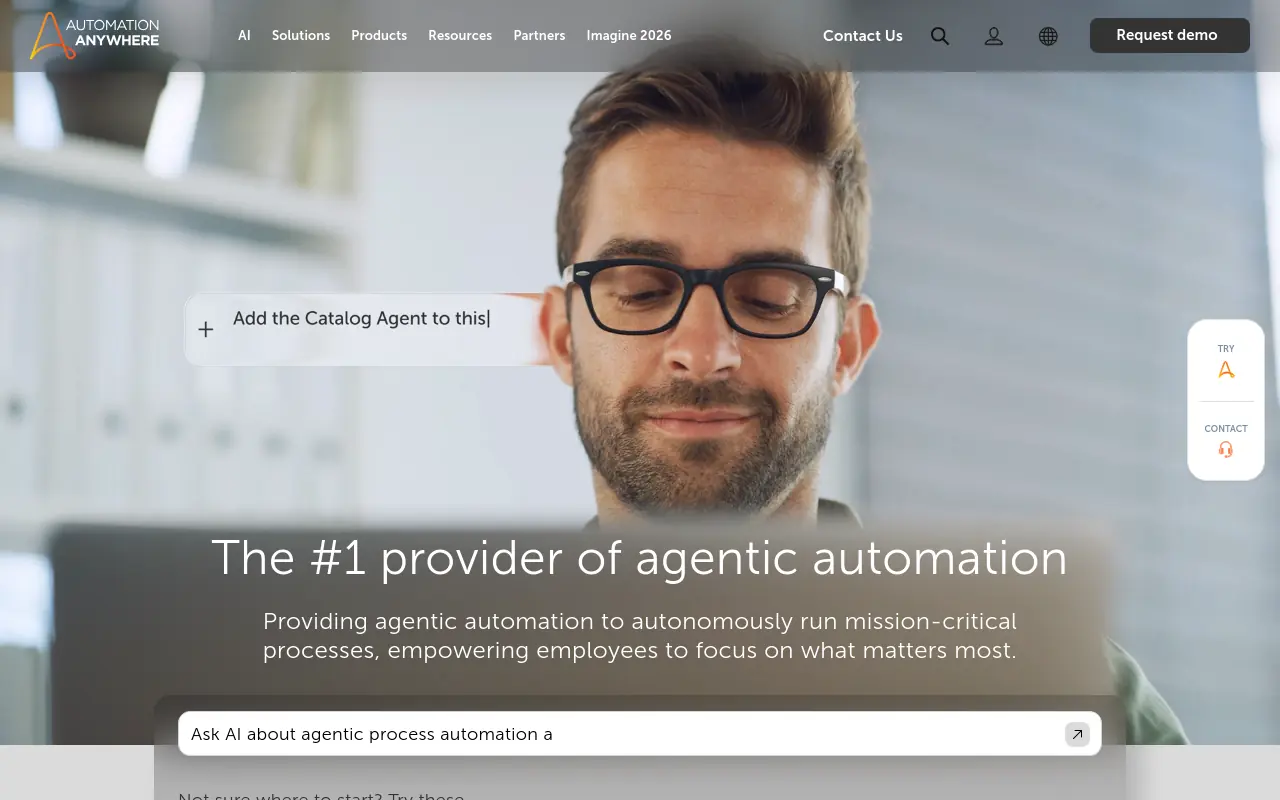 Automation Anywhere is the clearest signal that enterprise automation has crossed a line. According to Automation Anywhere’s April press release, 61% of Q4 software bookings came from AI, as enterprises deploy agentic AI to run core business functions rather than assist workers. Its Agentic Process Automation platform combines AI, process intelligence, and human-in-the-loop orchestration across IT, finance, healthcare, and HR. The tradeoff is real: this is an enterprise-grade system built for organizations with existing RPA infrastructure. Operators at 15-to-50-person startups will find the implementation surface area exceeds what their team can absorb without dedicated technical resources.
3. Kore.ai - Best for Conversational AI with Deep Enterprise Integration
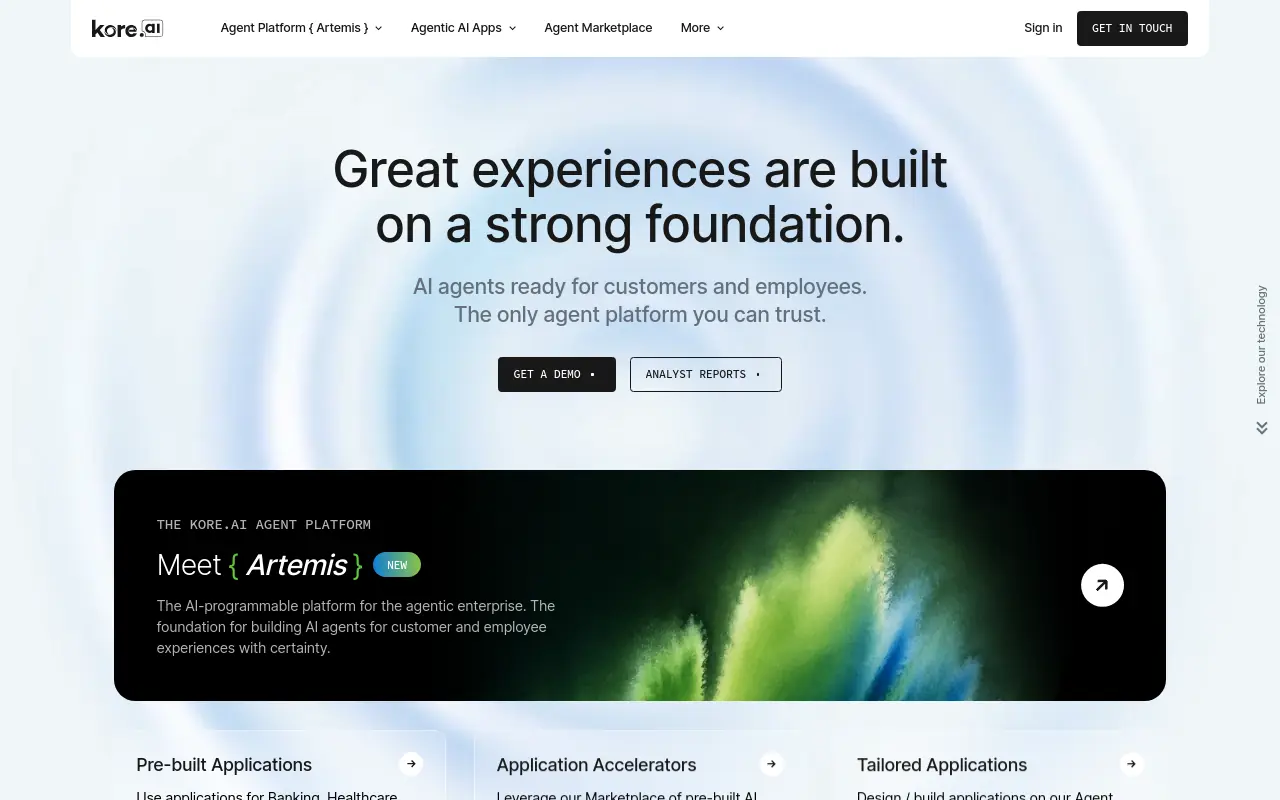 Kore.ai’s XO Platform is the strongest option for organizations that need conversational AI to work across complex, pre-existing enterprise systems rather than starting from a clean slate. It ships with pre-built industry agents and orchestration logic designed for regulated environments, which compresses deployment time significantly for teams in banking, healthcare, and insurance. The platform’s depth is also its constraint: teams without a dedicated conversational AI architect will spend more time configuring intent models and integration layers than they will getting autonomous work done in the first weeks.
4. Glean - Best for Knowledge Work Automation Across Internal Data
The best developer frameworks for building agentic AI systems are code-first tools that give engineering teams explicit control over state, memory, and agent coordination logic. Glean occupies a different category entirely: it is an enterprise search and knowledge platform with an agentic layer that resolves tasks by retrieving grounded, organization-specific context rather than generating from a generic LLM. That distinction matters for knowledge work. A sales team using Glean to answer competitive questions or draft account summaries gets answers anchored to internal data, not hallucinated from training weights. The limitation is scope: Glean excels at knowledge retrieval and task resolution within that lane, but it is not a general-purpose multi-agent orchestration platform.
5. Moveworks - Best for IT and HR Service Desk Automation at Scale
IT operations teams often describe the same frustration: the platform that promised autonomous ticket resolution ends up routing requests faster rather than resolving them without human touch. Moveworks positions its platform as capable of end-to-end autonomous task execution, citing agentic AI that “autonomously understands, plans, executes, and adapts to complete any request” and customer testimonials specifically citing reduced time to resolution without human touch. It is purpose-built for IT and HR service desks, handling password resets, software provisioning, policy questions, and benefits inquiries without a human in the loop for the majority of request types.
The tradeoff is vertical depth over horizontal breadth: Moveworks performs best when the use case stays within IT and HR, and organizations expecting cross-functional agent coordination will need a different layer on top.
6. Domo - Best for Data-Driven Agent Orchestration Tied to Business Intelligence
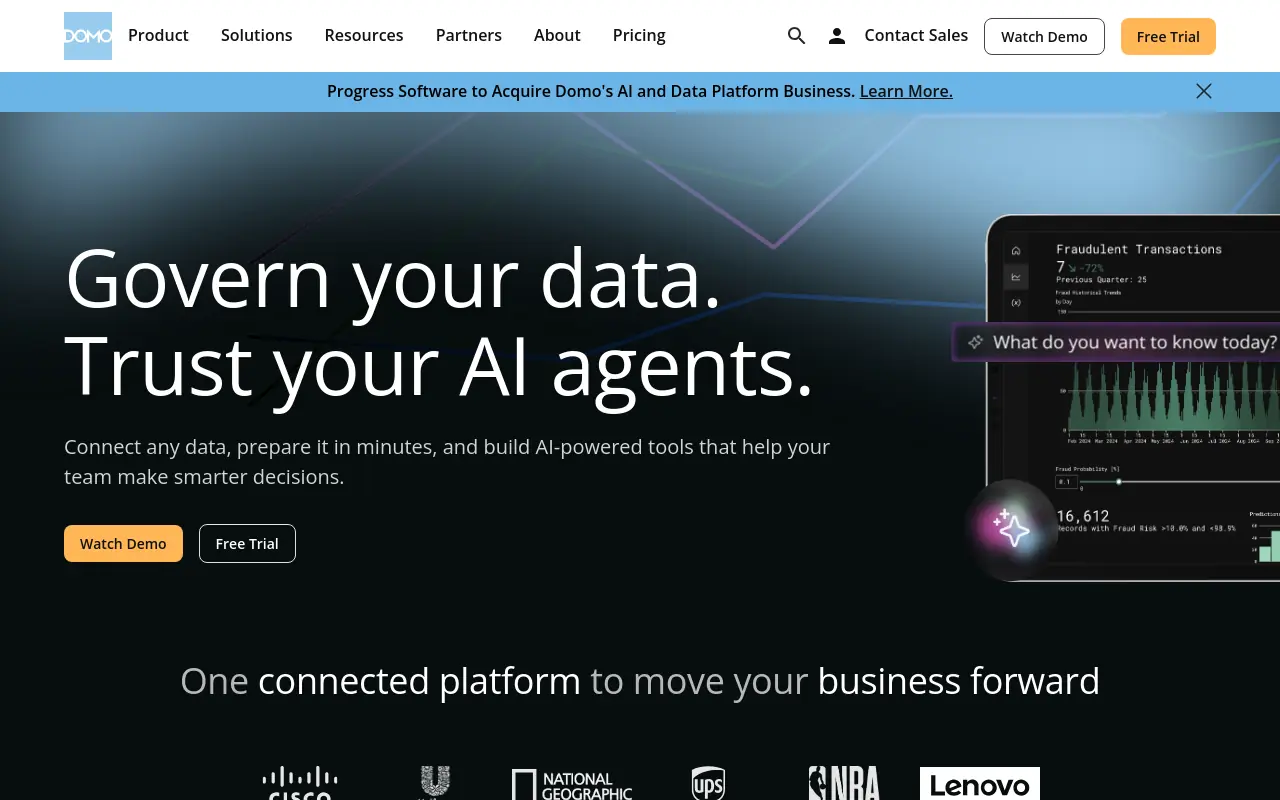 Domo earns its place on this list for a specific operator profile: teams where agentic actions need to be grounded in live business data rather than static knowledge bases or pre-mapped workflows. Its agent orchestration layer connects directly to the BI infrastructure most enterprise teams already run, meaning agents can trigger actions based on metric thresholds, anomaly detection, or report conditions without a separate data pipeline. The honest limitation is that Domo’s agentic capabilities are strongest when the organization is already invested in Domo as its BI platform. Bringing it in purely for agentic AI without the underlying data infrastructure is a harder sell to a buying committee.
7. Rasa - Best for Teams That Need Full Control Over Agent Conversation Logic
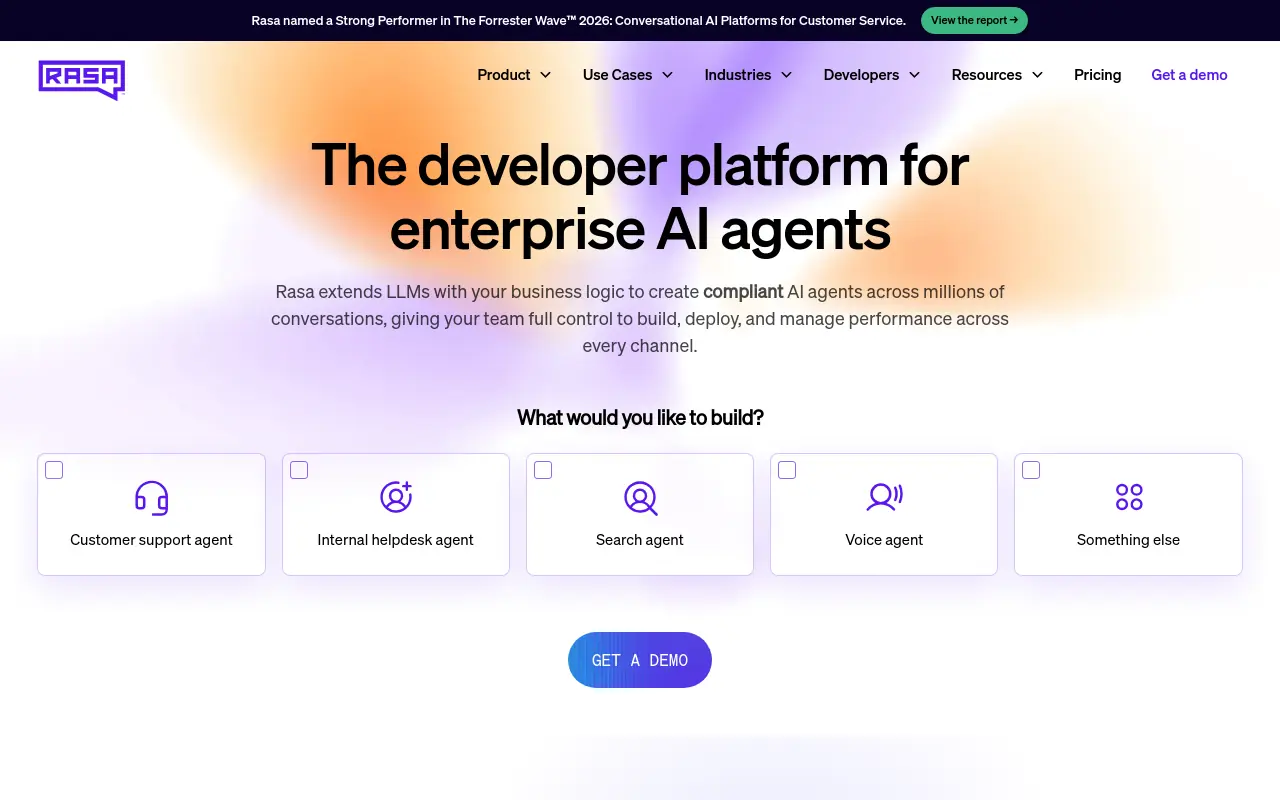 For teams that need full control over agent conversation logic, open-source frameworks are the natural reference point. Rasa sits in that control-first philosophy: it is an open-source conversational AI framework that gives engineering teams complete ownership over dialogue management, NLU models, and integration logic. That control comes at a cost. Rasa requires ongoing engineering investment to maintain, and operators who want agents that run without a developer on call should look elsewhere.
8. Appian - Best for Process-Centric Agentic AI in Regulated Industries
 Appian is the right shortlist entry for organizations where every automated action needs an auditable process record. Its low-code platform combines case management, workflow automation, and AI orchestration in a way that satisfies compliance requirements in financial services, government, and healthcare. Agents in Appian operate within defined process boundaries, which is a feature for regulated buyers and a constraint for everyone else. Teams that need agents to reason across ambiguous, unstructured work rather than execute within predefined process maps will find Appian’s structure limiting.
9. Sierra - Best for Customer-Facing Agentic AI with Brand-Safe Conversational Design
Sierra builds AI agents designed to represent consumer brands in customer interactions, handling returns, troubleshooting, and account management with a tone and persona calibrated to each brand. Its agents are built for high-stakes, customer-facing conversations where off-brand or incorrect responses carry real business risk. Best for B2C companies with large support volumes. The tradeoff: Sierra’s focus on brand safety and consumer CX means it is not designed for internal or back-office automation.
10. Cognigy - Best for Omnichannel Contact Center Agent Automation
Cognigy specializes in deploying AI agents across voice and digital contact center channels simultaneously, with native integrations into telephony platforms like Genesys and Avaya. Its agentic AI handles complex customer journeys end-to-end and escalates to human agents with full context transfer. Best for enterprises running high-volume contact centers across voice and chat. The tradeoff: its depth in contact center infrastructure makes it overkill, and expensive, for teams without that operational context.
11. Decagon - Best for AI Agents Trained Deeply on Product-Specific Support Knowledge
Decagon builds customer support AI agents that are trained on a company’s specific documentation, past tickets, and product knowledge, enabling resolution of nuanced, product-specific questions that generic LLM agents fail on. It targets SaaS companies that need agents capable of handling technical support without constant human escalation. Best for product-led growth companies with complex support surfaces. The tradeoff: the onboarding process requires substantial knowledge base investment upfront.
12. Exabeam - Best for Agentic AI Applied to Cybersecurity Threat Detection and Response
 Exabeam applies agentic AI to security operations, deploying agents that autonomously correlate threat signals, investigate anomalies, and recommend or execute response actions across SIEM and SOAR workflows. It is purpose-built for security teams drowning in alert volume who need agents that reason about attacker behavior, not just match rules. Best for enterprise SOC teams. The tradeoff: it is narrowly scoped to cybersecurity and offers no value outside that domain.
13. Aisera - Best for Unified AI Agent Platform Spanning IT, HR, and Customer Service
 Aisera delivers a single agentic AI platform that spans IT service management, HR operations, and customer support, reducing the need to deploy separate point solutions for each function. Its generative AI layer handles intent recognition and autonomous resolution across all three domains from one admin interface. Best for mid-to-large enterprises seeking consolidation. The tradeoff: breadth across three domains means each individual use case may lack the depth of a purpose-built specialist tool.
Related Reading
- How to Measure AI Agent ROI Before You Scale
- The Future of Agentic AI For Customer Support Explained
- 13 Best AI Agent Integrations to Automate More in 2026
- 14 Best Browser Use Agent Tools for AI Web Automation 2026
- The Ultimate AI Automation Tutorial for Beginners (2026)
- AI Agent vs Assistant: Key Differences Compared (2026)
- How To Measure AI Agent ROI With Proven Metrics
- What Are Parallel AI Agents? A Complete 2026 Guide
- 13 Best AI Agents for Marketing Teams in 2026
- How to Set AI Agent Permissions Without Losing Control
Common Use Cases for Agentic AI Platforms - Mapped to the Right Tool Type
The use case sitting in front of you right now almost certainly spans three or more systems. That single fact eliminates more platform options than any feature comparison will. Starting from a job-to-be-done, rather than a capability checklist, is the fastest way to avoid deploying a powerful tool in the wrong layer entirely.

Cross-Tool Operations Coordination - Why Embedded Agents Win Where Single-Surface Platforms Stall
Most ops coordination failures are not skill failures. They are architecture failures. According to industry data from Menlo Ventures, 2025: The State of Generative AI in the Enterprise, agentic AI is increasingly handling multi-step workflows that span CRM, email, calendar, and communication platforms. The problem is that most platforms require you to bring all those surfaces into their environment, rather than meeting work where it already lives. Embedded agents operate inside the tools your team already runs on, so the coordination overhead disappears rather than shifting to a new interface.
There is a second, less discussed problem layered on top of the architecture question: trust. Teams new to agentic AI carry a legitimate concern that an agent operating with broad system access could perform unintended or destructive actions, erasing files, overwriting records, sending communications without review.
That fear reflects a real gap between what agentic platforms promise and what they make legible to the humans overseeing them. SkyDive’s granular permissions model addresses this directly. Each teammate operates within a defined scope, its own per-teammate sandbox with browser, so no single agent holds unchecked access to the full environment.
The coordination happens across teammates, not through a single actor with unlimited reach. That structural choice is what makes it possible to get real output from AI tools rather than carefully worded suggestions that still require a human to execute every consequential step.
Multi-channel access and scheduled runs extend that reliability further: workflows don’t stall because a teammate is waiting on a trigger a human forgot to pull. Pre-built teammate templates give teams a starting point that is already scoped correctly, so the first deployment isn’t a blank-canvas exercise in figuring out what the agent should own.
Institutional Knowledge Persistence - The Use Case Developer Frameworks Were Never Built For
Single-agent platforms handle retrievable, structured information reasonably well. What they fail at is preserving the sequential, exception-driven judgment that senior operators carry. Single-agent context amnesia between sessions means each new task starts cold. The tacit reasoning behind edge-case decisions evaporates exactly as it would when a key person leaves. Multi-agent platforms with persistent memory layers address a categorically different problem: keeping the judgment behind recurring decisions permanently in the system, not in the person who last handled it.
*Key takeaway: In architectures where session-persistent memory is native rather than bolted on, recurring-process judgment remains in the system rather than the person, a structural distinction, not a feature claim.*
SkyDive’s multi-teammate architecture is built around this principle: each teammate carries its own scope and history across sessions. The institutional knowledge doesn’t live in one context window that resets. It lives in the teammate assigned to that domain, accumulating across every run. When a key operator is out, the judgment they would have applied to an edge case isn’t missing; it’s encoded in the teammate that has handled that workflow before.
This also speaks to a coordination problem teams consistently underestimate: the back-and-forth that accumulates when multiple people share ownership of a multi-step process with no single source of truth for where a task stands. SkyDive is built to coordinate complex, multi-step workflows without losing track of who owns what at each stage, and to reduce the communication overhead that pulls teams away from high-impact work and into status-update loops. MCP (Model Context Protocol) support means that teammate memory and tool integrations are not siloed; context can be shared deliberately across the system, not reconstructed from scratch each session.
Sales Pipeline Management - Which Agentic AI Platform Type Wins at Revenue Workflows
Revenue workflows sit at the intersection of every trust concern agentic AI raises. Teams new to deploying AI in a sales context often encounter a version of the same fear that appears in any high-stakes agentic deployment: that an agent might execute a financial or commercial action, a purchase, a commitment, a communication, without explicit human approval. That concern is well-founded when the platform doesn’t separate the agent’s execution authority from its reasoning scope. SkyDive’s granular permissions and team collaboration model means that the teammates involved in revenue workflows operate within explicitly defined boundaries. An agent can draft, stage, and prepare, but the permissions model determines what it can execute without a human in the loop.
Google Cloud AI ROI Research and Menlo Ventures both point to enterprise AI adoption accelerating fastest in organizations that have solved the trust and governance layer first, not the capability layer. The teams winning at revenue workflows with agentic AI scoped access correctly from the start, then expanded deliberately as confidence accumulated. That is the architectural posture SkyDive’s multi-teammate, permission-gated design is built to support.
How to Choose the Right Agentic AI Platform in 2026 - Without Becoming the Engineer
Most platform comparisons hand you a feature matrix and call it a buying guide, but the column that determines whether agentic AI actually reduces your workload rarely appears on any vendor’s spec sheet. What you need to evaluate before anything else is how much human coordination a platform still requires once the agents are running, because a tool that forces an ops leader to manually sequence handoffs between agents has not eliminated the skilled-labor dependency; it has repackaged it. The criteria below are built around that single pressure point, so you can shortlist platforms that compound your team’s capacity rather than quietly draft you as the engineer holding them together.

Stop Scoring Features, Start Measuring Setup Friction Before the First Autonomous Action
One thing most vendor comparisons never surface directly: the failure mode that kills most agentic deployments is not weak AI reasoning but the “operator-as-engineer trap,” when agents cannot route work between themselves, the human coordinator becomes the integration layer, recreating the exact skilled-labor dependency the platform was supposed to eliminate. A platform that requires the ops leader to manually decompose tasks and sequence handoffs is a more expensive version of the problem it claims to solve. Enterprise shortlisting criteria should therefore include a platform’s native ability to hand off context between specialized agents without human orchestration, because that single capability determines whether automation compounds or collapses back onto the people it was meant to free.
“Most AI agent platform comparisons conflate very different product types (developer frameworks, automation tools, cloud services, full lifecycle platforms), making it hard for non-engineers to evaluate apples-to-apples.”
Most teams handle platform evaluation the way they handle software procurement: download the comparison sheet, score the columns, pick the winner. The hidden cost surfaces later, usually during the first implementation sprint, when “low-code setup” turns out to mean low-code for engineers. According to Menlo Ventures’ State of Generative AI in the Enterprise report, enterprise AI adoption is accelerating at a pace with no modern precedent, yet platforms that require heavy upfront workflow mapping create measurable friction that slows real deployment relative to those that can be stood up from a plain description. The ops leader who absorbs that friction becomes the integration layer. That is not automation. That is a more expensive version of the problem.
Question 1: Does It Start From a Description or Demand a Diagram?
The fastest signal of setup friction is the onboarding question a platform asks first. If the answer is a canvas, a node editor, or a workflow template, the platform is asking you to be the architect before any work runs. A platform that starts from a plain-language description of the role compresses time-to-first-autonomous-action from weeks to a single session, which is most beneficial when your ops team has no dedicated engineering support and cannot afford a multi-sprint build before seeing results.
Question 2: Do Multiple Agents Hand Off Natively, or Do You Wire Every Transition?
Single-agent platforms consistently recreate the human-as-router bottleneck. When agents cannot pass context to each other without a human sequencing the steps, the ops leader becomes the orchestration layer.
Agentic AI Platform Selection Checklist for Heads of Operations
Use the following criteria before finalizing your shortlist. A platform must clear all five to warrant a pilot:
| Evaluation Question | What a Passing Answer Looks Like | |
|---|---|---|
| 1 | Does setup start from a plain-language description or require a workflow diagram? | Plain-language description → agent materializes without pre-mapping |
| 2 | Do multiple agents hand off context natively, or must a human wire every transition? | Native multi-agent handoff with no human-as-router step |
| 3 | Does the platform persist agent memory and judgment across sessions? | Session-persistent memory per agent, not per-conversation context only |
| 4 | Can a non-engineer modify or extend an agent without filing a ticket? | Business-user-editable scope and instructions |
| 5 | Does the vendor provide documented production deployments (not just pilots) at comparable org size? | ≥1 verifiable customer reference at your headcount and vertical |
Any platform that fails criteria 2 or 3 reintroduces the human-as-router bottleneck this guide is designed to help you avoid.
Related Reading
- What Is Agentic AI for Business Operations and Why It Matters
- 12 Best AI Automation for Sales Tools That Actually Work
- Gumloop vs Zapier: Which Tool Wins for AI Automation?
- 13 Best AI Automation Software Tools I Tested in 2026
- 18 Best AI Agent Platform Comparison Tools for 2026
- 13 Top AI Automation Tools I Tested and Ranked for 2026
- How Much Does an AI Agent Cost? 2026 Pricing Breakdown
- Zapier AI Agent: Build and Automate Smarter Workflows
- AI Agent Framework Comparison: Top Picks Ranked for 2026
- 15 Best Agentic Automation Tools to Try in 2026
- RPA vs AI Agents: Which Automation Wins in 2026?
Next steps
If your team keeps restarting workflows from scratch every time a key person moves on, the path forward starts with treating judgment as infrastructure, not headcount. The right architecture keeps the reasoning behind recurring decisions in the system, not in the person who last handled it. Start with our AI teammates.
The 80-plus percent AI project failure rate is a surface-deployment problem, not a model problem, which means shortlisting on raw capability is the wrong axis entirely. At the same time, the operator-as-engineer trap kills most agentic deployments before they compound: when agents cannot hand off context between themselves natively, the ops leader becomes the integration layer, recreating the exact skilled-labor dependency the platform was supposed to eliminate. Together, those two patterns point to one practical step: evaluating a platform that deploys from a plain-language description and coordinates across multiple teammates without a human wiring every transition.
Start with SkyDive to see how it structures a teammate around a description, assigns persistent memory, and keeps the judgment behind recurring workflows in the system after the session ends.
Frequently Asked Questions
What actually makes an AI platform ‘agentic’ and how is that different from a regular AI chatbot?
A true agentic AI platform must autonomously pursue a goal, make sequential decisions, and take adaptive action without requiring human step-by-step instruction. A regular chat interface returns a single answer and waits; an agentic system updates its state after each action and chains tasks without a human intervening between steps, which is the mechanical foundation of autonomous AI workflow.
What should I look for when evaluating agentic AI platforms?
Three criteria separate a genuinely agentic platform from one that just wears the label: it must form a plan from a goal without a human pre-mapping the steps, use external tools and update its approach based on what it observes, and hand work to another agent or process without the operator acting as the router. Beyond those, this guide flags ‘least context-switching required’, not ‘most powerful AI’, as the axis that separates deployments that reach production from those that don’t, since the 80%+ AI project failure rate is driven by implementation and integration challenges, not model capability gaps.
How do the three types of agentic AI platforms compare and which fits my team?
Developer frameworks give engineering teams fine-grained control but break down the moment a non-engineer needs to modify an agent without filing a ticket. Enterprise SaaS platforms offer speed without writing agent logic but rarely survive past the pilot when teams must migrate to a new surface. Embedded agents, like SkyDive, deploy directly into Slack, email, and iMessage where work already happens, skipping the migration failure mode entirely; they are best suited for organizations that want AI teammates operating within their existing workflows without requiring a new interface.
Why do single-agent tools break down on complex workflows?
A single agent operating under real operational load doesn’t fail loudly, it stalls quietly, hitting the boundary of its context window or delegated scope and returning output that looks complete but has shed the institutional thread. The deeper problem is that when a single agent hits a task boundary, the operator becomes the router, manually copying output from one tool and pasting context into the next, consuming the same cognitive bandwidth as doing the work manually. Multi-agent systems eliminate that bottleneck by handling handoffs automatically, which is why industry benchmarks from 2025 show multi-agent systems outperforming single-agent setups by measurable margins on complex, cross-tool tasks.
Does this guide include a comparison table of the different platform types?
Yes, this guide includes a table mapping each platform type to its best-fit buyer and the condition under which it breaks down: developer frameworks suit teams with dedicated ML engineers but fail when a non-engineer needs to make changes; enterprise SaaS platforms suit business teams wanting speed but fail when adoption requires migrating to a new surface; and embedded agents suit organizations where work already lives in Slack, email, and iMessage, and are noted as skipping the migration failure mode that undermines the other two types.