What Is Agentic Automation and How It Works
What is agentic automation and why ops leaders who automate tasks but still own all coordination are building the wrong thing.
 Skydive 28 min read

Table of contents
Automating tasks never killed coordination overhead. Agentic automation is the architecture built to close that gap, and the distinction changes every tool decision you make next.
Automation promised to give you time back. For most ops leaders, it delivered something narrower: a faster version of one step, inside a process that still needed a human to hold it together. That gap has a name now, and understanding it changes how you think about every tool you evaluate next. The common assumption is that if you automate enough individual tasks, the overall coordination load will go away by itself. It does not, and the reason why is exactly what agentic automation is designed to address.

“Firms are being pitched expensive multi-agent orchestration systems ($25K+) before they’ve even solved basic workflow automation, creating a mismatch between solution complexity and actual problem complexity.”
Agentic automation is the category built to close that gap. Platforms like AI teammates represent what this looks like in practice: agents that perceive context, make decisions, and act across systems without waiting for a person to route the next step. But before evaluating any tool, the definition itself is worth getting right. See our AI teammates for how this works in practice.
Agentic automation is an approach where autonomous AI agents pursue a goal across multiple steps, tools, and decisions without a human directing each action. The agent receives an objective, reasons about how to reach it, selects the right tools, and executes, adapting when conditions change. That last part matters.
Earlier automation executes a fixed sequence. Agentic automation constructs the sequence dynamically. The distinction is not cosmetic; it determines whether the system can handle the real work that lands on an ops team every day, where almost nothing arrives exactly as expected.
According to the Asana Anatomy of Work Index (2026), knowledge workers spend 60% of their time on coordination overhead: chasing status updates, searching for information, and managing handoffs rather than doing the skilled work they were hired for. Asana’s research frames this as a coordination problem, not a task-volume problem. The overhead grows from friction between people, systems, and decisions. Automating individual tasks does not touch that. The coordinator is still there, just managing fewer keystrokes.
60% of work time lost to coordination overhead
Previous automation required someone to pre-define every branch. Generative AI removes that constraint.
Key takeaways
- Agentic automation doesn’t replace a task, it replaces the coordinator who was routing work, carrying context, and making judgment calls between tasks that no single automation tool ever touched.
- Traditional RPA was built for predictable, rule-bound steps inside a single system. The coordination load between systems, the part that still needed a human, was never in scope.
- What a coordinator actually does breaks into four things: read context from wherever it lives, decide what happens next, route work to the right tool or person, and carry institutional knowledge forward so the same call doesn’t have to be made twice.
- The highest-value question about any agentic use case isn’t ‘what task does this replace?’, it’s ‘what category of coordination burden disappears entirely?’
- Governance isn’t a post-deployment checklist. Permission scoping is a design decision, and skipping it means a confidently wrong agent compounds errors at machine speed.
- Adoption fails when the automation layer requires a human to maintain the connection between it and the tools teams already use, that person is usually the ops leader who bought the platform.
- SkyDive closes that gap by deploying AI teammates that handle real work directly inside Slack, email, iMessage, and web chat, no separate interface, no one assigned to hold the system together.
Why Traditional RPA and Rule-Based Automation Can’t Solve the Coordination Problem
Most operations leaders reach for RPA because it promises to remove human effort from repetitive work, and it does, right up until the process hits something it wasn’t scripted for. The real coordination burden lives in the gaps, the exceptions, the handoffs, and the judgment calls that rule-based and even AI-augmented systems still route back to a person. Understanding exactly where that boundary sits, and why it exists by design rather than by accident, is what this section is about.

What RPA Was Built to Replace vs. What It Can’t Touch
The common assumption among heads of operations is that if you automate enough individual tasks, the overall coordination load will go away by itself. Traditional RPA excels at predictable, rule-based, repetitive tasks using structured data. That is its design brief, not a limitation someone overlooked. A bot can extract line items from a structured invoice, paste them into an ERP field, and do it a thousand times without complaint. UiPath, one of the most widely deployed RPA platforms, built its core value proposition precisely on this: mirror what a human does on a screen, then do it faster and without breaks.
The problem surfaces the moment real work arrives. RPA breaks the moment it hits an unexpected input, a changed screen layout, or a request that doesn’t match the template. That brittleness is a direct consequence of its script-first architecture, not a fixable bug. A vendor updates their PDF format. The bot stops. Someone gets paged. That someone is usually you.
And in operations teams, “you” rarely has a spare hour. The back-and-forth of chasing a stalled bot, escalating to engineering, and re-running the process is exactly the coordination overhead that keeps skilled people away from high-impact work.
Why Intelligent Automation Still Follows a Script
AI-powered automation adds machine learning, OCR, and NLP on top of the rule engine. It can read a handwritten form or parse an unstructured email. That is genuinely useful. But from our market understanding, intelligent automation still follows predefined paths: it handles more inputs but doesn’t reason about what to do next.
The distinction matters more than most vendors admit. Reading a messier input is not the same as deciding what the input means for three downstream systems that each have a different status on the same request. The script got longer. The coordinator didn’t go anywhere.
What teams actually need is something that can coordinate complex, multi-step workflows without losing track of who owns what at each stage, a problem that neither classical RPA nor standard intelligent automation was architected to solve. As Knowlee notes, the gap between task automation and genuine workflow reasoning is where most operations teams stall.
SkyDive is built from the ground up for this coordination layer. Because each teammate has its own identity, scope, and history, and teammates hand off to each other without anyone mapping the steps in advance, it can hold context across steps, systems, and people simultaneously. Memory and persistence mean the state of a workflow doesn’t evaporate between runs; scheduled runs mean the next step triggers automatically rather than waiting for someone to notice the silence.
The Three Seams Where Every Real Request Falls Apart
The seams are where work actually breaks. The first seam is between systems: status in one tool contradicts status in another, and a human has to reconcile them. The second is between steps: an automated handoff stalls and nobody re-triggers it until someone notices the silence. The third is between intent and template: the request is close enough to a known workflow to seem automatable, but different enough that the bot rejects it or, worse, completes the wrong action with no flag raised, moving bad data downstream before anyone notices.
These three seams share a root cause: the automation has no persistent understanding of the request’s intent, no memory of prior steps, and no ability to reach across systems to reconcile conflicting states. ASTACKRA draws this distinction clearly: script-based systems, however augmented, cannot reason about what an input means for downstream systems in different states.
SkyDive addresses all three seams structurally. Granular permissions and team collaboration mean the right teammate, human or AI, owns each step explicitly, so ownership gaps don’t create silent stalls. Multi-channel access means a request arriving through any surface is routed into the same coordinated workflow rather than dropping into a separate queue. Run code & commands, read & write files, browse the web, search the web, host web apps, process media, and the agent can give itself new tools as needed, so contradictory statuses get surfaced and resolved rather than silently propagated. The result is less status-update overhead for the team and more of their attention on the work that actually moves outcomes forward.
How Agentic Automation Works - The Four Core Components That Replace the Coordinator
Agentic automation works by replacing the coordinator, not just the tasks the coordinator was handling. The question worth asking before you buy into any definition is: what does a coordinator actually do all day? They read context from wherever it lives, decide what needs to happen next, route work to the right tool or person, and carry institutional knowledge forward so the same judgment call doesn’t have to be made twice. The four components of agentic automation map directly onto those four behaviors.
1. The Perception Layer - How Agentic Systems Read the World Before Acting
Perception is where most prior automation broke down. According to industry research, 80 to 90 percent of all enterprise data is unstructured, meaning it lives in emails, documents, support tickets, and system logs rather than tidy database rows. The Komprise State of Unstructured Data Management Report reinforces the scale of that problem: companies are collecting more unstructured data than ever while spending more to manage it, even as AI demands on that data grow.
Traditional rules-based automation required structured triggers; it could only act on data it was explicitly told to expect. An agent’s perception layer reads across all of it, gathering real-time context from APIs, documents, and live environments before a single decision is made. That is the difference between a bot that waits for the right input and a coordinator who actually reads the room.
One failure mode that surfaces quickly in practice: ops and marketing teams who try to run five or more agents simultaneously without a structured perception layer hit a wall fast. The cognitive cost of manually tracking what each agent has and hasn’t read becomes exhausting within hours. SkyDive’s per-teammate sandboxes with dedicated browser layers mean each AI Employee reads its own slice of the environment independently, so the perception work stays distributed without landing back on a human to orchestrate it.
2. The Planning Engine - Dynamic Task Decomposition That Replaces the Human Coordinator
Once an agent perceives the situation, it breaks the goal into a multi-step plan without a human designing that plan in advance. This is autonomous decision-making in its most operationally relevant form: the agent evaluates objectives, weighs options, and constructs a workflow dynamically. The honest limitation here is real. LLM-based planning engines can hallucinate steps, confidently executing subtasks that are logically impossible or contextually wrong. This component performs best when the goal is well-scoped and the available tools are clearly defined.
A subtler planning failure, one that only becomes obvious after something breaks, is the handoff problem in distributed agent architectures. When one component retrieves, another analyses, another validates, and another decides, the ownership boundaries between them are non-obvious to design upfront. Replacing a central coordinator with multiple specialized agents doesn’t eliminate coordination complexity; it relocates it into the seams between components. SkyDive is built multi-teammate by default, with granular permissions and explicit team collaboration controls, so the ownership of each step in a multi-step workflow is traceable rather than implicit, which is precisely what prevents that complexity from becoming invisible until it fails.
3. The Memory Architecture - Short-Term Context and Long-Term Knowledge That Sustain Multi-Step Work
Memory is the component that separates an agent from a very capable one-shot tool. Short-term context keeps the agent oriented across the steps of a single task; long-term memory means the judgment from one completed task compounds into the next, rather than resetting. The practical failure mode without it is familiar: the agent loses context between runs, repeats mistakes it already made, and requires the human to re-explain the situation. When memory works, tribal knowledge stops walking out the door with the person who held it.
SkyDive builds memory and persistence into every AI Employee by default. Scheduled runs compound that persistence. The agent doesn’t just remember what it did last session; it applies that institutional knowledge on the next scheduled cycle without prompting. For ops teams whose biggest hidden cost is back-and-forth communication overhead to re-establish status at the start of every task, this is the component that removes the overhead: the agent already knows where it left off, who owns what next, and what the last judgment call produced.
Understanding the four components tells you what agentic automation is capable of in theory. The more useful question for an ops leader is which specific coordinator burdens disappear first, and that is exactly what the next section maps out.
4. The Action Executor - Safe Tool Calling and API Execution That Closes the Automation Loop
The action executor is what makes planning consequential. It selects and calls the correct tools, software integrations, or databases at each step, replacing the manual context-switching an ops professional does when moving between a CRM, a billing system, a project tracker, and an inbox inside a single workflow. Enterprise operations teams routinely span many software tools, and the cognitive cost of routing work between them is not trivial.
Cloud-based automation platforms compound this problem by introducing rate limits, credits, and quotas that quietly cap what the action executor can actually do, ceding control of the pipeline to the platform vendor rather than the ops team. SkyDive’s action executor runs inside the tools ops teams already use, with MCP (Model Context Protocol) support and built-in tool integrations that handle work spanning those tools without requiring a human engineer to stitch the connections together. The result is an agent that routes itself rather than waiting for a person to open the next tab, and that frees the ops or marketing professional to preserve their time for the strategic, writing, and positioning work that compounds over time rather than the integration work that resets every sprint.
Real-World Use Cases for Agentic Automation and What They Actually Remove from Your Plate
The highest-value question to ask about agentic automation isn’t “what task can this replace?” It’s “what category of coordinator burden disappears entirely?” That reframe changes everything about which use cases you should target first.
IBM frames this as a shift from automating a task to orchestrating an outcome, and the distinction is precise: when an agent owns the sequencing, triage, and escalation logic across an entire workflow, what leaves your plate isn’t the doing of tasks. It’s the judgment between them. The point is worth naming directly: agentic AI doesn’t primarily eliminate task execution, it eliminates the coordination overhead between tasks, the sequencing and triage judgment that consumed roughly 60% of knowledge workers’ time precisely because context was always shifting.
That is a categorically different relief than traditional automation has ever delivered.
One real cost of getting this wrong is the anxiety engineers feel when they watch peers claim to fully automate complex multi-step workflows while their own team is still manually chasing status updates, pinging the right person, and losing institutional judgment every time someone leaves. The goal is to make judgment persistent so it doesn’t walk out the door when people leave, and to get real output from AI tools. That distinction separates a genuine shift in operational leverage from an expensive proof-of-concept.
According to Gartner’s March 2025 research, agentic AI will autonomously resolve 80% of common customer service issues without human intervention by 2029. That number matters less as a support metric and more as a signal about what coordination overhead actually looks like when it’s gone.
80% of customer service issues resolved autonomously by 2029
1. Autonomous Customer Support Resolution - Eliminating the Ticket Queue Entirely
Customer support is the clearest proof point for coordinator replacement. In practice, agentic systems don’t just answer tickets; they detect issues, cross-reference knowledge bases, attempt resolution, and escalate only genuine unknowns, a sequencing capability that is architecturally distinct from any helpdesk automation that still requires a human to assign or prioritize the queue. Broader trends across customer-facing teams show agentic approaches already reshaping resolution benchmarks in measurable ways.
When teams handle end-to-end this way, what leaves the human coordinator’s plate isn’t ticket-answering; it’s the triage judgment that previously decided which ticket needed a person at all. That’s the invisible work that consumed hours, and it disappears as a category rather than shrinking as a volume.
SkyDive’s multi-teammate architecture is built precisely for this pattern. Each teammate operates in its own per-teammate sandbox with browser access, so a support agent can cross-reference live knowledge sources, attempt resolution steps, and hand off to a specialist teammate, all without a human coordinator deciding who owns what at each handoff. Granular permissions and team collaboration controls mean escalation paths are defined once and enforced automatically, and memory and persistence ensure the context built during one interaction doesn’t evaporate before the next. The back-and-forth communication overhead that used to land on a coordinator’s plate, the “did anyone pick this up?” messages, stops being a category of work at all.
2. IT Incident Triage and Self-Healing - Removing the On-Call Scramble from Your IT Team
Anyone who has managed an on-call rotation knows the real cost isn’t the incident. It’s the scramble: pulling context from three monitoring tools, pinging the right engineer, and manually re-triggering a stalled remediation step at 2 a.m. Agentic systems reduce mean time to resolution by owning that coordination layer, correlating signals across systems and attempting self-healing before a human is ever paged. The on-call burden that remains is genuine exception handling.
SkyDive’s scheduled runs and MCP (Model Context Protocol) support make this concrete rather than theoretical. A teammate can be configured to monitor signals on a defined cadence, pull context from connected systems via MCP, attempt a remediation sequence, and page a human only when the resolution path is genuinely novel, not because the routing logic hasn’t been encoded yet. Multi-channel access means the escalation reaches the right engineer wherever they are, without a coordinator manually deciding the communication path. What SkyDive teams we work with find is that the anxiety about “falling behind” on agentic workflows dissolves once teammates are producing real operational output rather than surfacing suggestions a human still has to act on manually.
3. Employee Onboarding Orchestration - Taking the 40-Tab HR Checklist Off Your Plate
Agentic automation handles the entire new-hire workflow, provisioning accounts, assigning equipment requests, enrolling in benefits, and answering day-one questions, without HR manually touching each system. This is the use case that most visibly frees HR business partners to do actual people work. Best for companies scaling headcount fast. The tradeoff is integration complexity: the agent is only as good as the systems it can actually reach and authenticate against.
4. Accounts Payable Invoice Processing - Removing Manual Data Entry and Approval Chasing
Finance teams in ops-heavy companies often spend more time chasing approvals than reviewing the numbers that actually matter. The gap between manual and automated invoice handling costs isn’t primarily in data entry speed; it’s in the approval routing, exception flagging, and follow-up emails that a coordinator was previously sending by hand. That invisible overhead is exactly what agentic systems absorb by owning the sequencing logic rather than just the data entry.
SkyDive’s pre-built teammate templates give finance teams a starting point that encodes this sequencing from day one. Routing logic, exception escalation, and approval chasing are defined in the template and persist across runs, so the judgment doesn’t have to be re-established each cycle. Coordinate your team through complex, multi-step workflows without losing track of who owns what at each stage: in an AP context that means the agent tracks invoice status, flags exceptions to the right approver via the right channel, and logs every state transition, so when an auditor asks what happened to a specific invoice, the answer is already there. The coordinator who used to send the follow-up emails doesn’t disappear; they move to reviewing genuine exceptions, which is the work that required their judgment in the first place.
5. Procurement Request Intake and Vendor Evaluation - Cutting the Back-and-Forth from Sourcing
Agentic automation in procurement captures purchase requests, checks spend policies, identifies preferred vendors, solicits quotes autonomously, and surfaces a ranked recommendation, removing the weeks of email ping-pong that typically define sourcing cycles. Best for procurement teams managing high request volume with lean staff. The honest limitation: agents struggle with novel spend categories where no historical vendor data or policy precedent exists, requiring human judgment to set the initial guardrails.
Related Reading
- How to Measure AI Agent ROI Before You Scale
- 13 Best Agentic AI Platforms in 2026 for Autonomous Work
- The Future of Agentic AI For Customer Support Explained
- 13 Best AI Agent Integrations to Automate More in 2026
- How To Measure AI Agent ROI With Proven Metrics
- 14 Best Browser Use Agent Tools for AI Web Automation 2026
- The Ultimate AI Automation Tutorial for Beginners (2026)
- AI Agent vs Assistant: Key Differences Compared (2026)
- What Are Parallel AI Agents? A Complete 2026 Guide
- 13 Best AI Agents for Marketing Teams in 2026
- How to Set AI Agent Permissions Without Losing Control
How to Secure and Govern Autonomous Agents - Before They Create a New Kind of Chaos
Deploying an autonomous agent without defining its permission boundaries first is a design flaw, and one that compounds quickly at machine speed. The question ops leaders rarely ask before go-live is the one that matters most: what happens when the agent is confidently wrong?

Permission Scoping Is the First Design Decision, Not an Afterthought
AI agent permissions are the architectural constraint that determines whether an agent produces outcomes or produces liability. A critical reality most teams discover too late: most production AI agents are governed only by system prompts, and system prompts can be ignored, overridden, or reinterpreted by the model at runtime.
That is not enforcement. It is a suggestion. Cycode documents this directly: prompt-only governance offers no real boundary on what an agent can access or act on, which means the “controls” many teams believe are in place offer far weaker assurance than they assume.
Pre-deployment testing, benchmarks, and red teaming do not close this gap. They do not provide the same level of assurance expected in safety-critical domains, and agentic AI in production is increasingly operating in workflows where the cost of a confident mistake is not theoretical.
SkyDive addresses this at the architectural layer rather than the prompt layer. Granular permissions are built into the platform by design, so each teammate operates within an explicitly scoped boundary. Per-teammate sandboxes mean that access granted to one teammate for one workflow does not bleed into unrelated tasks.
A concrete example makes this real: an agent with read/write access to your CRM, given a vague instruction to update account statuses, has no way to distinguish a genuinely inactive account from one that is mid-negotiation unless the permission scope explicitly excludes active-deal records. That distinction has to be designed in. It cannot be patched after the first mistake.
With SkyDive’s granular permission model, that boundary is set structurally, not hoped for at inference time.
Why “What Did the Agent Do?” Is the Wrong Question
Most teams, when they first add monitoring to an agentic workflow, instrument outputs: what action the agent took, what record it updated, what message it sent. That is the wrong layer. Because agents make decisions dynamically rather than following fixed scripts, Kiteworks has reported that operations teams need visibility into why the agent took each action, not just what it did. Without tooling that captures the reasoning trace, exception triage becomes guesswork, and anyone who has spent an afternoon reconstructing why a stalled workflow fired incorrectly knows how expensive that guesswork gets.
This is also where institutional knowledge becomes a governance risk. If the person who designed the agent’s logic leaves the team, and the reasoning behind each decision boundary left with them, you are not just debugging a workflow, you are rebuilding judgment from scratch. SkyDive’s memory and persistence layer addresses this directly: the platform is built to make judgment persistent so it does not walk out the door when a teammate does. Decision context, workflow ownership, and task state are preserved across runs and across team members, so the logic that governs agent behavior does not live only in one person’s head.
The Three Failure Modes Governance Must Anticipate
Three failure modes surface repeatedly in production agentic automation governance work, and platforms such as Island.io have highlighted the importance of anticipating each one before deployment.
- Permission creep, where an agent granted broad access to complete one task retains that access across unrelated tasks.
- SkyDive’s per-teammate sandbox architecture structurally constrains this; each teammate’s access is scoped to its defined role, not inherited from a shared execution context.
- Confident hallucination, where the agent takes a decisive action based on a plausible but incorrect inference, with no human checkpoint in the workflow to catch it before the error propagates.
- Kiteworks identifies ungoverned autonomous execution as a direct compliance and audit exposure risk precisely because of this failure mode; the agent does not signal uncertainty, it acts.
- Scope drift, where a goal stated at a high level causes the agent to invoke tools or modify records outside the intended workflow boundary.
- This failure mode tightens considerably when agents are deployed with minimum-necessary permissions from day one, which is the posture SkyDive’s granular permission model enforces by default, not as an optional configuration.
Multi-teammate coordination compounds all three risks when governance is treated as an afterthought. When complex, multi-step workflows span several teammates, each with browser access, multi-channel reach, and MCP-connected tooling, the blast radius of a single misconfigured permission or an unchecked confident inference grows proportionally. SkyDive’s team collaboration model is built so that ownership at each workflow stage is explicit and tracked, reducing the conditions under which scope drift can propagate silently before anyone notices.
What Software Tools Provide Agentic Automation and the Deployment Model Most Platforms Skip
Most agentic automation platform comparisons stop at features, but the deployment model determines whether automation actually reduces the work your team carries day to day. The platforms covered here each make a distinct architectural bet about where agents should live relative to the tools operators already use. That bet shapes adoption more than any capability benchmark.
1. SkyDive - Best All-in-One Agentic Automation Platform for Enterprise Deployment
Feature comparisons dominate most agentic automation platform evaluations. Buyers score reasoning engines, count integrations, and benchmark RPA compatibility, then pick the highest-scoring tool and expect adoption to follow. According to Fluid Labs’ 2025 analysis, the real failure point is rarely capability: 42% of enterprise AI initiatives are abandoned because the automation layer sits outside the tools where work happens. The platform that wins a feature comparison and the platform that actually reduces coordination burden are often not the same product.
Several agentic automation platforms have earned genuine traction, each with a distinct deployment philosophy. SkyDive’s AI teammates shows up in Slack, email, iMessage, and web chat, conversation surfaces the team already lives in. iMessage support is novel across the competitive set. That distinction matters most when the ops team is small and no one has bandwidth to maintain a parallel system. The honest trade-off: teams that need deep enterprise orchestration across dozens of regulated systems may require more configuration than an embedded model natively provides.
Dataiku positions itself at the intersection of data science and agentic workflow governance, giving data teams a structured environment to build, test, and audit multi-step agent pipelines. Its stated strength is reproducibility, agents run inside a governed workspace where every decision is logged and traceable, and this positioning is most credible for teams whose primary concern is auditability rather than speed of deployment. It is most valuable when a dedicated ML team is already owning the automation roadmap.
Rasa is a developer platform for enterprise AI agents that extends LLMs with business logic and deterministic control, giving engineering teams code-level control over agent behavior without rebuilding from scratch. The constraint is scope: Rasa excels at conversation but requires additional tooling when the automation crosses into backend orchestration or cross-system task execution.
Acuvate layers agentic AI reasoning on top of existing RPA infrastructure so that legacy automation gains judgment without requiring a full rebuild. The practical limitation is that when the underlying bot breaks, the agent stalls, and the coordination burden returns to the operator.
The embedded vs. external deployment decision is the variable that determines whether an agentic platform reduces friction or adds a new layer to maintain. As industry research shows, 88% of AI proof-of-concepts never reach production.
If your organization has a large, established team with an offshore VA or BPO contract already absorbing coordination work, or if you’re a solo operator running a one-person business, agentic automation at this layer is likely oversized for where your operational friction actually lives, and the deployment overhead won’t pay back at that scale.
2. Dataiku - Best for Data-Science-Led Agentic Workflow Governance
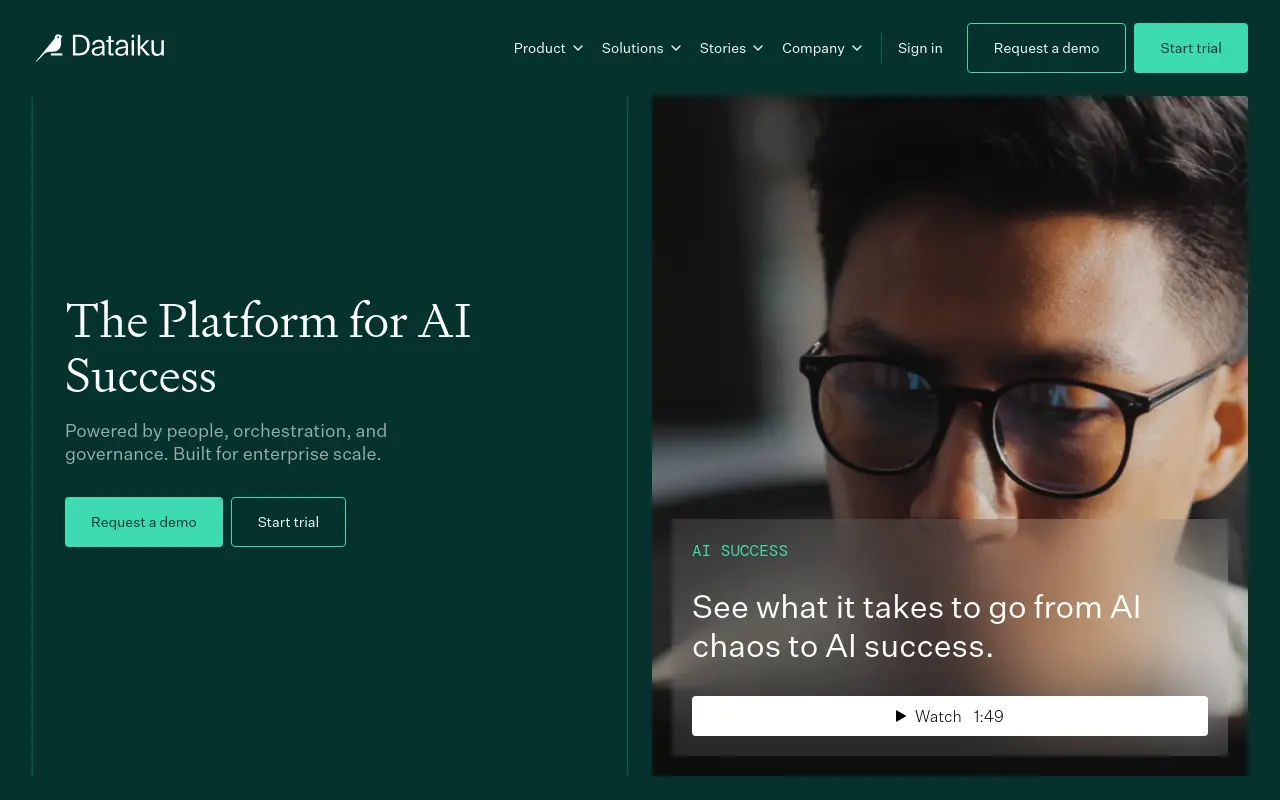 Dataiku positions agentic automation as an extension of its existing MLOps and data pipeline infrastructure, making it the strongest choice for organizations where data science teams, not IT, own automation strategy. Its visual recipe-and-flow model accelerates agent design, but teams expecting a pure no-code experience will hit friction fast once workflows require custom tool integrations.
3. Rasa - Best Low-Code Agentic Platform for Conversational Automation at Scale
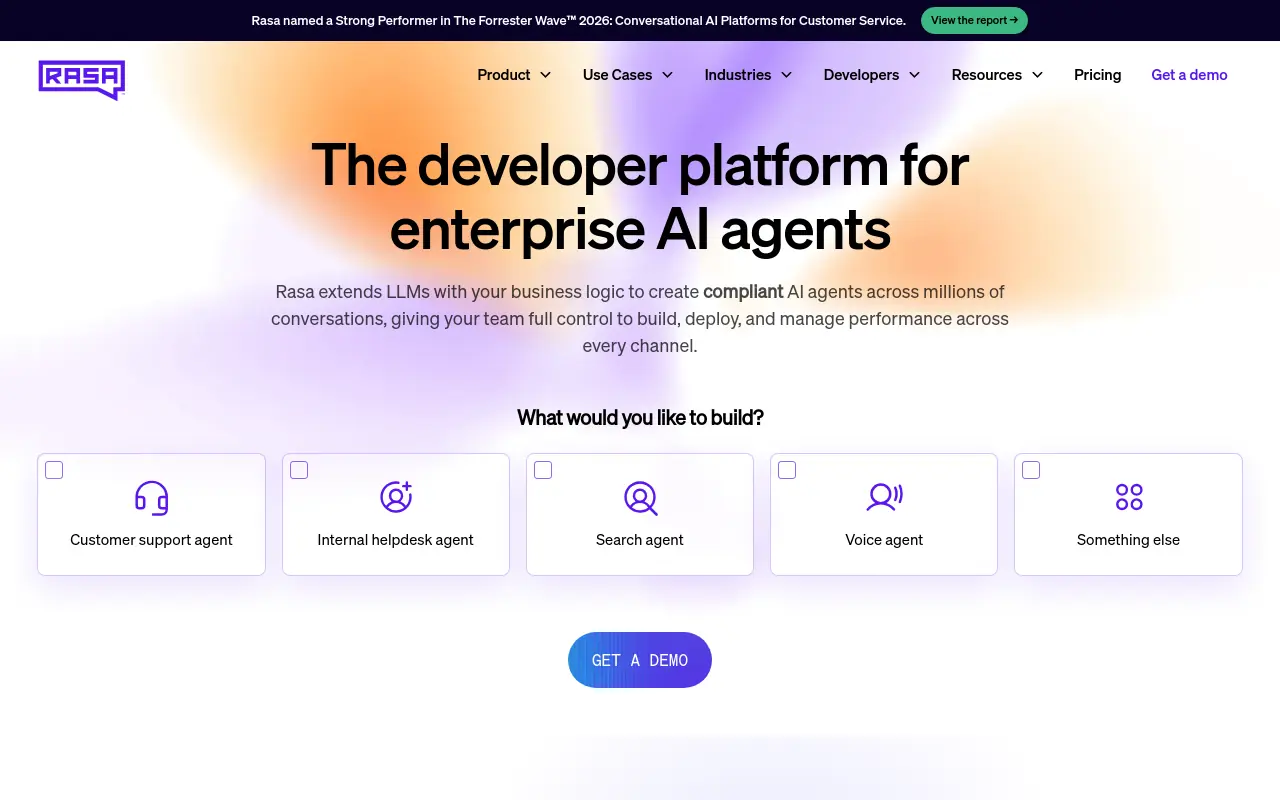 Rasa’s low-code framework lets product and automation teams build agentic systems around conversational interfaces without deep LLM engineering expertise. It’s purpose-built for customer-facing automation where dialogue management, fallback handling, and channel flexibility matter most. The key limitation is scope: Rasa excels at conversational agents but lacks the broad back-office process automation depth that pure RPA-adjacent platforms offer.
4. Acuvate - Best for Agentic AI Layered on Top of Existing RPA Infrastructure
Acuvate targets enterprises already running RPA at scale who want to inject agentic decision-making, dynamic exception handling, predictive routing, autonomous escalation, without ripping out existing bot infrastructure. It’s the pragmatic bridge between legacy RPA and true agentic automation. The tradeoff is that its value is heavily dependent on the maturity of the underlying RPA estate; greenfield deployments see slower ROI.
5. Embedded vs. External Deployment Model - The Architecture Decision Most Platforms Skip
Most agentic automation platforms default to external agent deployment, a standalone system that calls into your stack via APIs, but embedded deployment, where agent logic lives inside the application layer itself, delivers lower latency, tighter data security, and more reliable context retention. For regulated industries or real-time workflows, embedded is often the correct model. The tradeoff is higher initial engineering cost and reduced portability across systems.
Related Reading
- What Is Agentic AI for Business Operations and Why It Matters
- 12 Best AI Automation for Sales Tools That Actually Work
- Gumloop vs Zapier: Which Tool Wins for AI Automation?
- 13 Best AI Automation Software Tools I Tested in 2026
- AI Agent Framework Comparison: Top Picks Ranked for 2026
- 18 Best AI Agent Platform Comparison Tools for 2026
- Zapier AI Agent: Build and Automate Smarter Workflows
- 13 Top AI Automation Tools I Tested and Ranked for 2026
- 15 Best Agentic Automation Tools to Try in 2026
- How Much Does an AI Agent Cost? 2026 Pricing Breakdown
- RPA vs AI Agents: Which Automation Wins in 2026?
Next steps
If your team has automated a dozen individual tasks and still owns every handoff, the path forward starts with recognizing that the unit of automation has to shift from a single step to an entire outcome.
The perception and memory architecture that lets an agent read unstructured context and carry judgment forward across runs means the coordinator role can actually be replaced, not just assisted. The embedded deployment model matters for the same reason the 88% proof-of-concept failure rate exists: an agent that requires a separate interface adds one more system to coordinate rather than removing the coordination layer entirely. Together, they point to deploying agents that live inside the tools where decisions already happen, with persistent memory that compounds rather than resets.
See AI teammates for the embedded deployment model that closes that gap. From there, you scope your first outcome, define the permission boundaries before go-live, and let the teammate handle the sequencing your team is currently doing by hand.
Frequently Asked Questions
What’s the actual difference between agentic automation and traditional RPA?
Traditional RPA executes a fixed, pre-defined sequence of steps and breaks the moment it hits an unexpected input, a changed screen layout, or a request that doesn’t match the template. Agentic automation constructs the sequence dynamically, the agent receives a goal, reasons about how to reach it, and adapts when conditions change, rather than following a script someone wrote in advance.
If I already use AI-powered automation, isn’t that basically the same thing?
Not quite. Intelligent automation adds machine learning, OCR, and NLP on top of a rule engine so it can read messier inputs like handwritten forms or unstructured emails, but it still follows predefined paths, it handles more input types without reasoning about what to do next. Reading a messier input is not the same as deciding what that input means for three downstream systems that each have a different status on the same request.
Why does automating individual tasks still leave my team drowning in coordination overhead?
Because the coordination problem isn’t about task volume, it’s about the friction between people, systems, and decisions. According to the Asana Anatomy of Work Index, knowledge workers spend 60% of their time on coordination overhead: chasing status updates, searching for information, and managing handoffs. Automating individual tasks doesn’t touch that; the coordinator is still there, just managing fewer keystrokes.
What does an agentic AI agent actually need under the hood to work across a multi-step workflow?
Four core components: a perception layer that reads unstructured context from APIs, documents, and live environments before acting; a planning engine that decomposes a goal into steps dynamically without a human designing the plan; an action executor that selects and calls the right tools or integrations at each step; and a memory architecture that maintains short-term context across a single task and compounds long-term institutional knowledge into future runs.
Where do multi-step workflows most commonly break down in practice?
At three seams: between systems, where status in one tool contradicts status in another and a human has to reconcile them; between steps, where an automated handoff stalls and nobody re-triggers it until someone notices the silence; and between intent and template, where a request is close enough to a known workflow to seem automatable but different enough that the bot either rejects it or completes the wrong action with no flag raised, moving bad data downstream before anyone notices.